

Table of Contents
- Does Coffee Actually Expire?
- Signs of Stale Coffee Beans
- Coffee Shelf Life After Roast Date
- Best By vs. Expiration: What Actually Matters
- How to Store Coffee Beans Fresh
- Is It Safe to Drink Expired Coffee?
- Roast Level and How It Affects Freshness
- Frequently Asked Questions
Last Updated: September 25, 2026
Does Coffee Actually Expire?
Coffee beans don't expire like food does, they won't spoil or become unsafe to drink. But they do lose quality over time. The real question isn't whether your coffee will harm you, it's whether it will taste good.
After roasting, beans begin losing flavor compounds and aroma almost immediately, faster when exposed to air, light, heat, or moisture. A sealed bag stays flavorful for weeks; an open bag loses quality in days.
At Tinto Coffee Roasters, we roast to order within 48 hours of shipment. This approach preserves the peak flavor window, that sweet spot where beans have had time to degas but haven't started to oxidize. Understanding this difference between expiration and freshness is the key to knowing how to tell if coffee beans are expired.

Signs of Stale Coffee Beans
Use a multi-point sensory checklist rather than relying on dates alone. This approach is more reliable and gives you confidence in your assessment.
Step 1: Visual Inspection
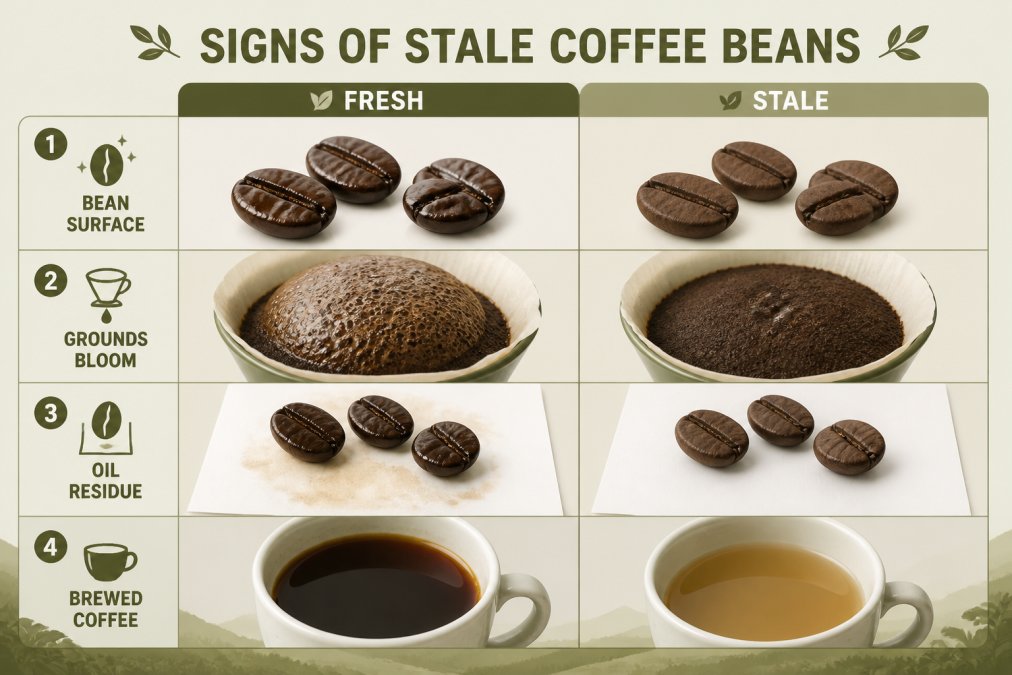
Examine the bean surface under natural light. Fresh beans show deep brown color with visible glossy oils; stale beans appear dull, grayish-brown, and matte. This shift occurs because oxidation breaks down surface oils.
Step 2: Aroma Test (Dry Smell)
Smell immediately, aroma fades within seconds of air exposure. Fresh beans have strong, complex scent from 6-12 inches away (fruity, nutty, chocolatey, floral, or spicy). Stale beans smell weak, musty, or cardboard-like. No aroma indicates lost volatile compounds.
Step 3: The Bloom Test (CO₂ Degassing)
This measures whether beans still contain carbon dioxide released during roasting. Grind 15-20 grams to medium consistency, place in a cup, pour just-boiled water (200-205°F) using twice the weight of water to grounds, and observe the first 30 seconds.
Fresh beans (1-4 weeks): vigorous bloom with visible dome and active bubbles. Moderately stale beans (4-8 weeks): weak bloom with subdued bubbling. Very stale beans (8+ weeks): little to no bloom, grounds stay flat.
CO₂ is one of the last compounds to leave beans. If bloom is absent, beans have been degassing for weeks. This test is more reliable than smell because it measures a chemical reaction, not subjective perception.
Step 4: Oiliness Check
Rub a bean on white paper. Fresh beans leave visible oily residue; stale beans leave little to none. Note: light roasts have less surface oil than dark roasts even when fresh, compare to your roast level.
Step 5: Taste Test (If You Brew)
If still uncertain after four tests, brew a small cup. Fresh coffee tastes bright and complex with clean finish; stale coffee tastes flat and one-dimensional with muted flavors.
Using the Checklist
If beans fail steps 2 and 3 (aroma and bloom), they're stale. Steps 2 and 3 alone are usually sufficient for reliable assessment.
Coffee Shelf Life After Roast Date
Most specialty coffee peaks for 2-4 weeks after roasting. After 4 weeks, quality declines noticeably; after 8-12 weeks, most people taste significant difference. Whole beans last longer than ground coffee (which peaks in 3-5 days). The roast date is your most important reference point, more useful than "best by" dates.
Best By vs. Expiration: What Actually Matters
These terms mean different things, and understanding the difference changes how you shop.
A "best by" date marks quality (typically 4-6 weeks post-roast); an "expiration" date suggests unsafety. Coffee doesn't truly expire, stale coffee won't make you sick, just taste bad. A roast date is most useful because it lets you calculate freshness yourself. Avoid vague "packed on" dates without roast information.
How to Store Coffee Beans Fresh
Storage is everything. Even the best beans go stale quickly in poor conditions.
The Airtight Container Rule
Oxygen is the enemy. Every time you open your bag, air enters and oxidation accelerates. Use an airtight container to minimize exposure.
Transfer beans to a container that seals completely. Glass jars with rubber seals work well. Vacuum-sealed bags also work. The key is keeping air out.
Don't use paper bags or regular plastic containers. Paper is porous. Regular plastic doesn't seal tightly enough. Both allow oxygen in.
If you buy whole beans in bulk, divide them into smaller portions. Keep one portion in daily use. Store the rest sealed. This way, you open the main container less often.
Temperature and Light Exposure
Heat speeds up oxidation. Store beans in a cool place. A pantry or cupboard is ideal. Avoid the kitchen counter near the stove or in direct sunlight.
Light also degrades beans. UV light breaks down flavor compounds. This is why quality coffee comes in opaque bags. Store your beans in a dark container or bag.
Never store beans in the freezer or refrigerator. This is a common mistake. Cold temperatures cause condensation when you open the container. Moisture damages beans. The temperature fluctuations also stress the beans.
Room temperature, around 65-70 degrees, is perfect.
| Storage Method | Best For | Shelf Life |
|---|---|---|
| Sealed bag in pantry | Short-term (weeks) | 2-4 weeks |
| Airtight glass jar | Medium-term | 3-6 weeks |
| Vacuum-sealed bag | Long-term | 6-8 weeks |
| Freezer | Emergency only | Months, but quality suffers |
Is It Safe to Drink Expired Coffee?
This question requires separating two different concerns: safety (will it harm you?) and quality (will it taste good?). Most people conflate these, but they're distinct issues.
Stale vs. Rancid: The Critical Distinction
When Coffee Becomes Unsafe
Three scenarios create actual health risks:
-
Mold Growth (Moisture Exposure)
- If beans have been exposed to moisture or stored in a damp environment, mold can develop.
- Mold is visible as white, green, or black spots on the bean surface or inside the bag.
- Mold produces mycotoxins, which can cause illness. If you see any mold, discard the beans.
- Prevention: Store beans in airtight containers in a dry environment (below 60% humidity).
-
Bacterial Contamination (Rare)
- Coffee beans are roasted at high temperatures (350-450°F depending on roast level), which kills most pathogens.
- Contamination is extremely rare in commercially roasted coffee sold in sealed bags.
- Risk increases only if beans are stored in conditions that allow bacterial growth (wet, warm, exposed).
- Prevention: Buy from reputable roasters and store properly.
-
Rancid Oil Breakdown (Extended Heat/Light Exposure)
- Prolonged exposure to heat (above 75°F consistently) and direct sunlight can cause oils to oxidize into compounds that may cause mild digestive discomfort.
- This is rare in home storage but more common in beans stored in clear bags on sunny shelves or near heat sources.
- Prevention: Store in cool, dark, airtight containers.
The Safety Timeline
- 0-4 weeks post-roast: Safe and optimal. No safety concerns.
- 4-12 weeks post-roast: Safe but stale. Quality declines, but no health risk if stored properly.
- 12+ weeks post-roast: Still safe if stored in cool, dry, airtight conditions. However, if stored improperly (exposed to heat, light, or moisture), rancidity or mold risk increases.
- Visible mold or chemical smell: Unsafe. Discard immediately.
The Bottom Line on Safety
Roast Level and How It Affects Freshness
Lighter roasts and darker roasts age differently. This affects how long they stay fresh.
Frequently Asked Questions
Can I still use 2-year-old coffee beans?
Two-year-old beans are technically safe to drink but likely past their prime. Coffee begins to lose flavor and aroma within 2-4 weeks of the roast date due to oxidation and CO2 degassing. After 2 years, beans stored in poor conditions will taste flat, bland, or cardboard-like. If stored in an airtight container away from light and heat, they may retain some flavor, but freshly roasted beans will always deliver better taste and aroma. For the best experience, use beans within 1-2 months of roasting.
What happens if I use expired coffee beans?
Expired coffee won't make you sick, but it will taste noticeably worse. Old beans produce weak, flat extraction with diminished acidity and bitterness. You may notice musty or cardboard flavors instead of the intended flavor profile. The bloom during brewing will be minimal or absent, indicating poor freshness. Ground coffee degrades faster than whole beans because oxidation accelerates with increased surface area. If your beans smell rancid or show visible mold, discard them rather than risk off-flavors in your cup.
Does the roast date matter more than the expiration date?
Yes, roast date is far more important. The roast date tells you exactly when peak freshness begins; an expiration date is often a generic estimate. Coffee is freshest 5-30 days after roasting, when CO2 is still degassing and flavor compounds are fully developed. A 'best by' date printed months ahead doesn't account for how the beans were stored. Roast-to-order coffee from sources like Tinto Coffee Roasters ensures you know the exact roast date and receive beans at their peak freshness window, typically within days of roasting.
How can you tell if coffee beans have gone rancid?
Rancid coffee beans smell distinctly off, musty, sour, or like cardboard rather than aromatic and rich. Visually, they may appear dull or tarnished instead of glossy, and ground coffee may show discoloration. Rancidity develops when beans oxidize over time or are exposed to moisture and heat. A sensory test: brew a small amount and taste it. Rancid coffee tastes harsh, bitter, or flat with no brightness or acidity. If beans show visible mold, are clumped from moisture, or smell unpleasant, discard them. Proper storage in an airtight container prevents rancidity and extends shelf life significantly.