

Table of Contents
- What the Coffee Roast Date Actually Tells You
- Best-by Date vs Roast Date: Why One Matters More
- The Coffee Degassing Period: Why Brewing Too Soon Ruins Flavor
- How Roast Level and Bean Density Change the Freshness Window
- Brew Method Timelines: When Coffee Hits Peak Flavor
- How to Store Coffee Beans Fresh After Opening
- Signs Your Coffee Has Gone Stale (and What to Do)
- Frequently Asked Questions
Last Updated: September 12, 2026
What the Coffee Roast Date Actually Tells You
The coffee roast date is the day the beans finished roasting, and it's the single most useful number on the bag for predicting how your coffee will taste. This guide from Tinto Coffee Roasters explains why it matters more than almost anything else printed on the packaging.

Here's the core problem: coffee is a fresh product, not a pantry staple. Once beans leave the roaster, they begin losing the aromatic compounds that make a cup taste alive. A bag stamped months ago may still be technically safe to drink, but it won't deliver the vibrancy you paid for. The U.S. Department of Agriculture's food date labeling guidance notes that most date labels refer to quality rather than safety, and coffee is a textbook example.
So what should you look for? A roast date, ideally printed as a specific day rather than a month. Below, we'll cover how that date shapes flavor, how it differs from a best-by date, and how to time your brewing.
Best-by Date vs Roast Date: Why One Matters More
A best-by date is a manufacturer's estimate of peak quality, while a roast date is a factual record of when roasting happened. Only one tells you how fresh the coffee actually is.
Best-by dates, sometimes called sell-by dates, are set by the packager and often stretch many months past roasting. That's convenient for grocery shelves, less useful for you: a bag with a best-by date six months out might have been roasted five months ago.
The roast date removes the guesswork. It's a fixed point you can count from. If you know a coffee was roasted ten days ago, you can decide whether that fits your brewing plans. If you only know it's "good until March," you're guessing.
That's why roast-to-order roasters print the date prominently: it signals freshness is the priority, not shelf stability.
| Label | What It Tells You | Who Sets It | Best Use |
|---|---|---|---|
| Roast date | When beans were roasted | The roaster | Judging freshness |
| Best-by date | Estimated peak quality window | The packager | Retail rotation |
| Sell-by date | When a store should pull stock | The retailer | Inventory management |
The Coffee Degassing Period: Why Brewing Too Soon Ruins Flavor
The coffee degassing period is the window right after roasting when beans release carbon dioxide, and brewing during this phase can produce uneven, underdeveloped cups.
Roasting triggers Maillard browning and caramelization, and those reactions trap carbon dioxide inside the bean's porous cell structure. Over the following days, that gas escapes. The rate isn't constant: most CO2 leaves in the first 48 to 72 hours, then slows into a long tail stretching two to three weeks. Roughly 40 percent of the trapped gas is gone within the first day, with the curve flattening after that (PubMed).
When you pour hot water over very fresh grounds, escaping CO2 pushes water away from the coffee particles, producing an aggressive bloom, a thick, bubbling dome in a pour-over or French press. That works against extraction: if gas blocks water, the water can't pull out sugars and acids evenly, leaving a cup that tastes flat on one sip and harsh on the next. Baristas call this inconsistent extraction.
Use the Bloom as a Real-Time Freshness Test
You don't need a roast date to judge freshness if you can read the bloom, a live diagnostic that changes predictably as coffee ages:
- Day 1 to 3: A violent, towering dome that rises fast and collapses slowly. The coffee is still off-gassing heavily and will likely brew sour and uneven.
- Day 4 to 10: A lively but controlled bloom, roughly double the volume of the grounds, that settles within 30 to 45 seconds. This is the sweet spot for most brew methods.
- Day 11 to 21: A modest bloom that barely puffs. Extraction is more predictable here, though delicate aromatics are starting to fade.
- Past 3 weeks: Little to no bloom. The CO2 is largely gone, and the cup tastes flat and papery regardless of how you brew it.
To run the test, pour a little hot water over fresh grounds, wait 30 seconds, and watch. If the bed barely reacts, the coffee is past its peak no matter what the bag says. If it erupts like a volcano, give it a few more days.
The fix for brewing too soon is patience: give beans a short rest after roasting. Most roasters ship within a day or two of roasting so the coffee arrives ready to drink.
How Roast Level and Bean Density Change the Freshness Window
Roast level and bean density both shift how long coffee stays at its best, so a single "drink within X days" rule never fits every bag.
Darker roasts spend more time in the roaster, driving off more of the volatile oils that carry aroma, and those oils are what oxidize over time. A dark roast can taste boldly good early, then fade fast. Lighter roasts retain more of those compounds and hold their character longer.
Bean density matters too. High-grown beans, like the specialty Colombian arabica we work with at Tinto Coffee Roasters, are denser because they develop slowly at altitude, so they roast evenly and hold their structure. Processing matters as well: washed coffees present cleaner acidity, while natural and pulped-natural lots carry heavier body and fruit notes that evolve differently as they rest.
The takeaway: judge freshness by taste and aroma, not a universal calendar. A dense, light-roasted bean and a porous, dark-roasted one don't age at the same rate.
Brew Method Timelines: When Coffee Hits Peak Flavor
Peak flavor arrives at different times depending on how you brew, because each method extracts differently. Espresso is the most sensitive, immersion methods the most forgiving, a matter of pressure, contact time, and how much a method amplifies small inconsistencies in the bean.
Here's how the timelines generally break down:
- Espresso: Best roughly 5 to 12 days after roasting. Espresso forces water through a compact puck at high pressure, so any trapped CO2 creates channeling, erratic flow, and shots that taste sour and thin one pull and harsh the next. Waiting a few days lets the puck settle and the extraction stabilize. Very fresh beans also produce an unstable, foamy crema that collapses quickly.
- Pour-over and drip: A sweet spot around 7 to 21 days. These methods reward consistency, and rested beans give you repeatable results. A V60 or Chemex will expose a too-fresh bean as a stalled bed and a hollow cup, while a standard drip machine is slightly more forgiving because of its longer contact time.
- French press and cold brew: More flexible, often good from about 7 to 30 days. Immersion and long contact time smooth over minor inconsistencies, and cold brew in particular can still taste sweet and round even from beans that are past their pour-over prime.
- Single-serve pods: Follow the roast date on the packaging. Freshly roasted, freshly packed pods hold their flavor far better than pods that sat in a warehouse, because the sealed capsule limits oxygen exposure even as the coffee continues to age.
Notice the pattern: the faster and more pressurized the brew, the narrower the freshness window. A regular drip machine at home gives you more room than an espresso enthusiast has.
Bean Density and Processing Shift the Clock
The roast date alone doesn't tell you when a specific bag peaks: two coffees roasted the same day can hit their best window a week apart depending on density and processing.
- High-grown, dense beans (think specialty lots grown at altitude) develop slowly, roast evenly, and hold their structure longer. They often need a longer rest, sometimes 10 to 14 days, before espresso tastes balanced.
- Lower-grown, less dense beans tend to peak sooner and fade faster.
- Washed coffees present cleaner acidity and a more predictable rest curve, usually ready on the shorter end of the window.
- Natural and pulped-natural lots carry heavier body and fruit-forward notes that evolve as they rest. Some drinkers find they taste best a few days later than a washed coffee from the same roaster, as the fruit notes settle and integrate.
How to Store Coffee Beans Fresh After Opening
The best way to store coffee beans fresh is to keep them away from air, moisture, heat, and light, ideally in an airtight container at room temperature. Oxygen is the main enemy once the bag is open.
Whole beans stay fresher longer than ground because less surface area is exposed to air. Grind right before brewing if you can; if you buy ground, choose a bag you'll finish within a couple of weeks.
A few storage habits that make a real difference:
- Transfer beans to an airtight container, or reseal the original bag tightly and squeeze out excess air.
- Keep the container in a cool, dark cupboard, not next to the stove or on top of the fridge.
- Skip the freezer for daily-use coffee. Repeated thawing introduces moisture. If you must freeze a large batch, portion it first and thaw once.
- Look for packaging with a one-way valve. It lets carbon dioxide escape without letting oxygen in, which protects flavor during shipping.
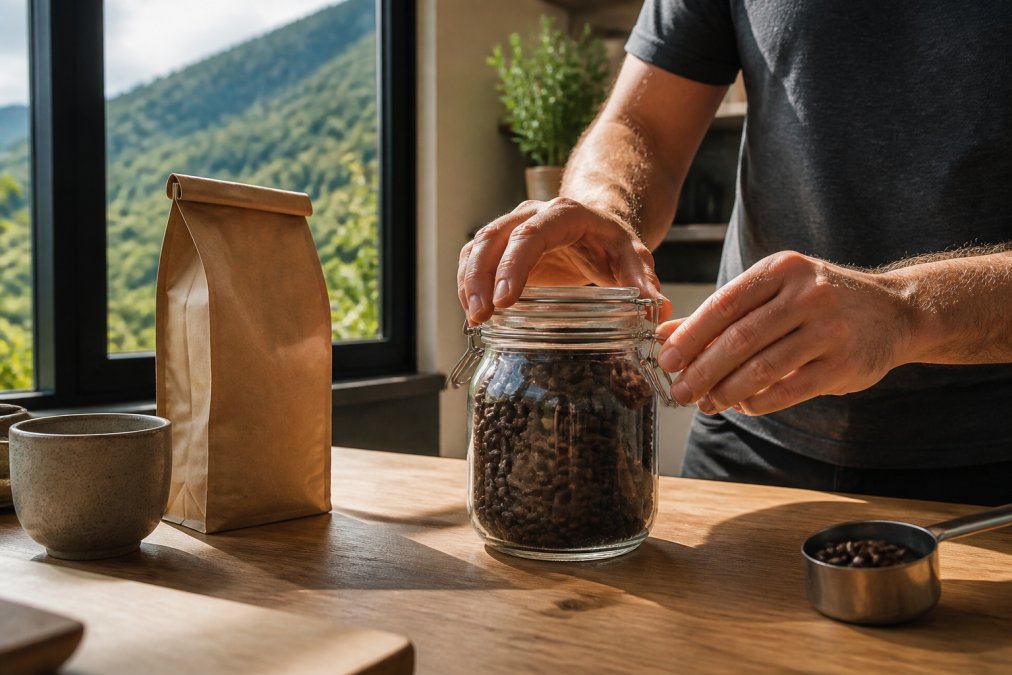
That's the storage side. Now here's how to tell when it's already too late.
Signs Your Coffee Has Gone Stale (and What to Do)
Stale coffee announces itself in the cup before you check a date. The clearest signs are a flat, papery, or cardboard-like taste and a dull, muted aroma when you open the bag.
Other signals to watch for:
- The bloom barely rises when you add hot water, a sign most of the carbon dioxide is long gone.
- The grounds smell faint or dusty rather than sweet and fragrant.
- The brewed cup tastes hollow, with acidity that's faded into something sour or simply absent.
When coffee reaches this point, you don't have to throw it out. It still works for cold brew, where long extraction can coax out remaining flavor, or as a base for baking. But it won't reward you the way fresh coffee does.
The real lesson is timing your purchase: buying smaller amounts more often beats stocking up, and a roaster who ships close to the roast date means your coffee arrives near its peak. Our Tinto Coffee Bag is roasted to order within 48 hours and sealed with a one-way valve, so it reaches you ready to brew. For portability, the Tinto Tube packs 54 grams of ground coffee in an airtight container, and "The Sophia" Colombian Pods cover mornings when convenience wins.

Specialty Coffee Association's guidance on coffee freshness and storage
Fresh coffee is a moving target, and the roast date is the only honest guide you have. Chasing flavor means buying from roasters who roast to order, storing beans properly, and brewing within the window that suits your method. Tinto Coffee Roasters roasts in small batches within 48 hours of shipping, grades every lot for quality and flavor consistency, and backs each order with a satisfaction guarantee. Get started with Tinto Coffee Roasters and taste what a genuinely fresh roast does for your morning ritual.
Frequently Asked Questions
What is the ideal roast date for coffee?
Most coffee reaches peak flavor 7 to 14 days after the coffee roast date. Lighter roasts often need closer to 10 to 14 days to finish degassing, while darker roasts peak around 5 to 10 days. Espresso tends to perform best between 7 and 12 days post-roast. After about 4 to 6 weeks, oxidation and staling take over, and the cup flattens noticeably.
How long after the roast date should you use coffee?
Aim to finish a bag within 4 to 6 weeks of the roast date for the best cup. Whole beans hold up longer than ground coffee because less surface area is exposed to oxygen. Once you open the bag, how to store coffee beans fresh becomes the deciding factor: an airtight container away from light and heat can preserve flavor for another 2 to 3 weeks.
Does roast date matter for espresso vs. drip coffee?
Yes, and the timelines differ. Espresso extraction is sensitive to carbon dioxide, so beans rested 7 to 12 days after the coffee roast date pull more consistent shots with better crema. Drip and pour-over methods are more forgiving and work well from about 5 to 20 days post-roast. Brewing espresso too soon often produces gushing, sour shots.
Is coffee roasted 4 months ago still good?
It is safe to drink but past its peak. After 4 months, volatile oils have oxidized, aromatic compounds have faded, and the flavor profile turns flat, papery, or cardboard-like. The coffee degassing period is long over, so the bloom in a pour-over will be minimal. It still works in a drip machine with milk or sweetener, but it will not taste like fresh specialty coffee.