

Table of Contents
- The Enemies of Coffee Freshness
- How to Store Coffee Beans Fresh: Step-by-Step
- Best Coffee Storage Containers for Whole Bean
- Can You Freeze Coffee Beans? The Full Answer
- How Long Does Coffee Stay Fresh After Roasting?
- Signs of Stale Coffee Beans (And What to Do)
- Common Myths About Storing Coffee Beans Fresh
- Frequently Asked Questions
Last Updated: September 2, 2026
Most coffee drinkers do everything right at the café counter and everything wrong at home. They buy excellent beans, then leave them in a clear glass jar on a sunlit counter, and wonder why the cup tastes flat by Thursday. Knowing how to store coffee beans fresh is the single biggest variable between a great cup and a forgettable one. At Tinto Coffee Roasters, we roast every bag to order within 48 hours of shipping, which means the freshness window starts the moment it arrives at your door. What you do next determines how long that window stays open. Below, we'll walk through the exact steps, the science behind them, and the mistakes that quietly kill flavor before you even reach the grinder.

The Enemies of Coffee Freshness
Four forces destroy coffee flavor, and they work fast.
Oxygen is the most aggressive. Once roasted, coffee beans are loaded with volatile aromatic compounds that oxidation breaks down quickly. Exposure to open air accelerates staleness in a way that no amount of good sourcing can overcome.
Moisture is the second threat. Coffee is hygroscopic, meaning it absorbs water from the surrounding air. High humidity causes beans to degrade faster and can introduce off-flavors that taste sour or musty. This is especially relevant in humid climates, coastal kitchens, for instance, are harder environments for coffee storage than dry, inland ones.
Light exposure, particularly from UV rays, degrades the oils in coffee that carry much of its aroma and flavor. Clear glass containers look beautiful on a counter, but they're essentially a slow roast in reverse.
Heat accelerates every chemical reaction happening inside the bean. Ambient temperature swings, like those near a stove or dishwasher, are particularly damaging because they cause repeated expansion and contraction that drives volatile compounds out of the bean faster.
According to the Specialty Coffee Association's research on coffee freshness, the degassing process, where carbon dioxide escapes from freshly roasted beans, peaks in the first 24 to 72 hours after roasting and continues for weeks. Managing that process is central to good storage.
How to Store Coffee Beans Fresh: Step-by-Step
Getting this right doesn't require special equipment. It requires understanding the sequence.
Step 1: Keep the Original Bag (Until You're Ready)
The biggest mistake most people make is transferring beans immediately into a different container. A well-designed coffee bag, like the one Tinto Coffee Roasters uses, includes a one-way valve that lets carbon dioxide escape during degassing without allowing oxygen in. That valve is doing real work. Leave the beans in it until you're ready to start brewing regularly.
Fold the top down tightly and use the built-in clip or tape it shut. Store it in a cool, dark pantry. This alone extends peak flavor by several days compared to an open container.
Step 2: Transfer to an Airtight Container
Once you're actively working through a bag, transfer to an airtight container with a proper airtight seal. The goal is to minimize oxygen exposure with every opening. Choose opaque materials, ceramic, stainless steel, or dark-tinted glass, over clear glass. Keep the container small enough that there's minimal air headspace above the beans.
Step 3: Choose the Right Spot in Your Home
The ideal storage spot is cool, dark, and dry. A pantry shelf away from the oven is the classic answer. Avoid:
- Above the refrigerator (heat rises, and fridges generate warmth)
- Next to the stove or toaster oven
- On a windowsill or open counter
- Inside a cabinet directly above a dishwasher
Thermal stability matters more than most people realize. A consistently cool spot beats a cold spot with temperature swings.
Step 4: Grind Just Before Brewing
Pre-ground coffee has dramatically more surface area than whole bean, which means oxidation accelerates at a much higher rate. Grind size doesn't change this equation, fine or coarse, ground coffee goes stale faster. Grinding just before brewing is the single highest-impact habit for cup quality. If you don't own a grinder, it's worth the investment before you spend money on premium beans.
| Step | Action | Key Benefit |
|---|---|---|
| 1 | Keep beans in original bag with one-way valve | Allows degassing, blocks oxygen |
| 2 | Transfer to opaque airtight container | Prevents light and oxygen exposure |
| 3 | Store in cool, dark, stable pantry spot | Protects against heat and humidity |
| 4 | Grind just before brewing | Preserves volatile compounds and aroma |
Best Coffee Storage Containers for Whole Bean
The container market has improved significantly, and the options range from basic to obsessive. Here's what actually matters.
Look for containers with an airtight seal rated for food storage, opaque walls, and a one-way valve or vacuum-pump mechanism. Ceramic canisters with rubber-gasket lids are a reliable everyday choice. Stainless steel options with a CO2 valve are popular with serious home brewers. Avoid anything made of clear glass without a UV coating, it looks great and does nothing for preservation.
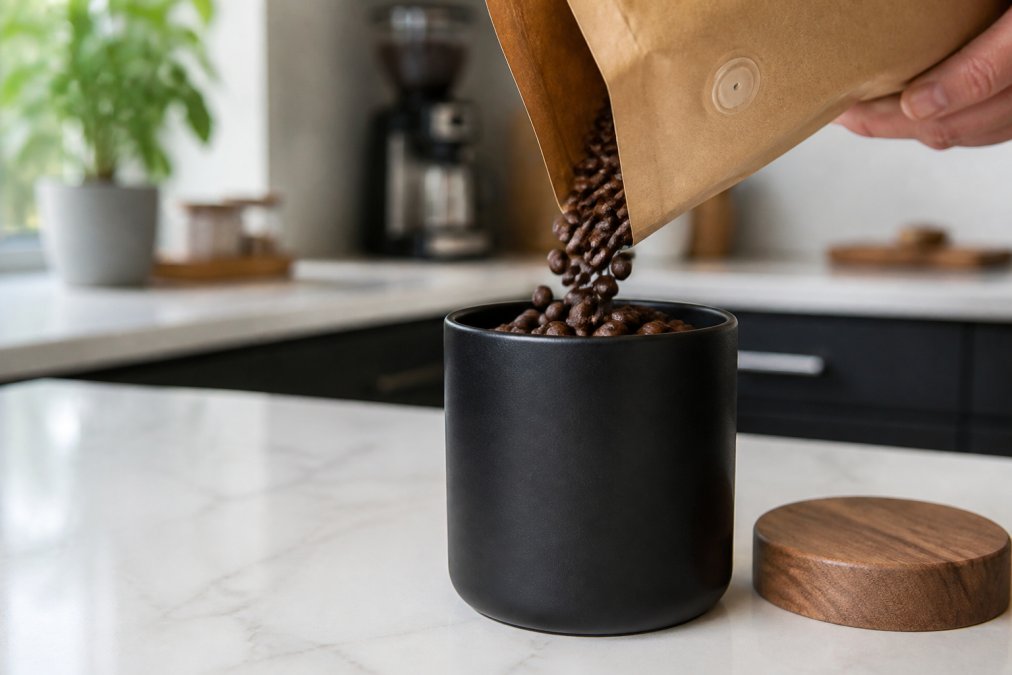
A storage vessel with a CO2 valve is particularly useful in the first two weeks after roasting, when degassing is most active. After that, the priority shifts to simply keeping oxygen and moisture out.
Vacuum Seal vs. Nitrogen Flush: Which Wins?
Both methods extend shelf life by removing or displacing oxygen, but they work differently.
Vacuum sealing removes air from the container entirely, creating negative pressure. It's effective and accessible, home vacuum-seal bags are widely available. The limitation is that it can also pull out some of the CO2 that fresh beans still need to degas, which may slightly flatten flavor in very fresh coffee.
Nitrogen flushing replaces oxygen with inert nitrogen gas, preserving bean integrity without the pressure issue. This is the method used by specialty roasters for long-term commercial storage. Home nitrogen-flush systems exist but are a niche investment.
For most home brewers, a quality vacuum-seal container hits the practical sweet spot. Nitrogen flushing is worth exploring only if you're buying in bulk quantities and storing for more than a month.
Can You Freeze Coffee Beans? The Full Answer
Freezing coffee beans is genuinely effective for long-term storage, but only when done correctly. The common objection is that freezing ruins beans, and that's true of one specific scenario: repeated freeze-thaw cycles. Each time beans warm up and cool down, condensation forms on the surface, which introduces moisture and accelerates degradation.
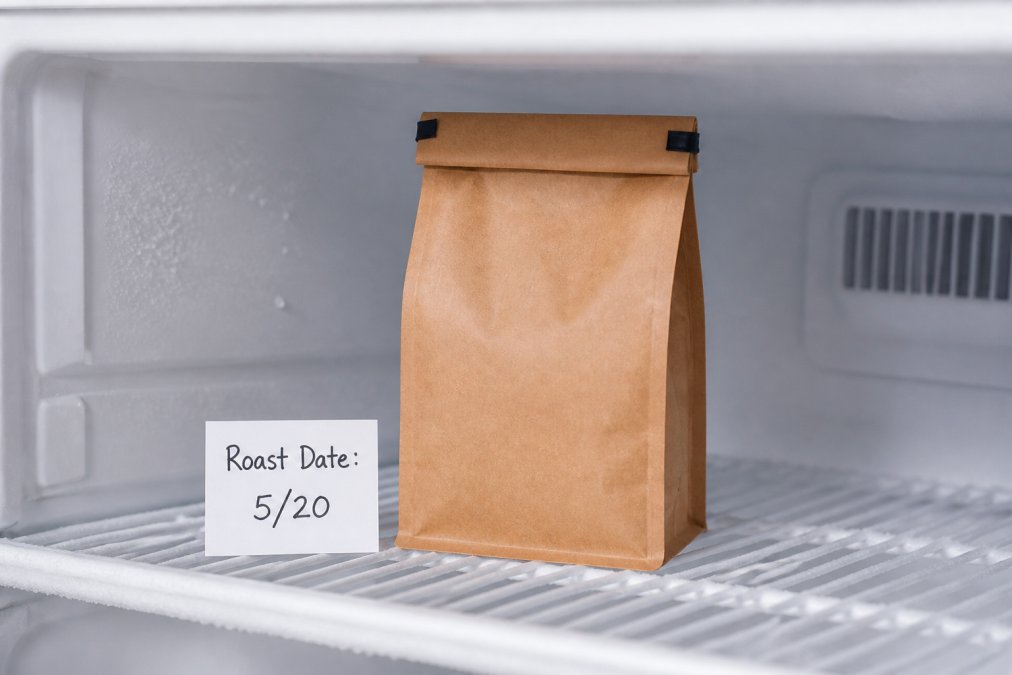
The correct approach is to freeze in single-use portions. Divide your beans into weekly quantities before freezing, seal each portion in an airtight bag with as much air removed as possible, and never refreeze a portion once it's been thawed.
According to research published by the University of Bath on coffee grinding at low temperatures, freezing beans actually produces a more consistent grind particle size, which can improve extraction. The science supports freezing when the method is right.
The Science of Thawing Frozen Beans Correctly
Thawing is where most people make the critical error. The rule is simple: bring the sealed, frozen portion to room temperature before opening it. This typically takes 30 to 45 minutes for a weekly portion. The reason is condensation, when cold beans hit warm, humid air, moisture forms on the bean surface instantly. By letting the sealed bag reach ambient temperature first, any condensation forms on the outside of the bag rather than on the beans.
Once thawed and opened, treat the beans like a fresh bag. Grind and brew within the week. Do not refreeze.
How Long Does Coffee Stay Fresh After Roasting?
How long does coffee stay fresh after roasting? Whole bean coffee is at peak flavor between 4 and 14 days after the roast date, and remains enjoyable for up to 4 to 6 weeks when stored properly in an airtight container away from heat, light, and moisture. Pre-ground coffee loses peak flavor within hours of grinding and becomes noticeably stale within 1 to 2 weeks.
The roast date is the number that matters, not the "best by" date, which is often set arbitrarily far in the future. Look for it on the bag. Tinto Coffee Roasters roasts to order within 48 hours of shipping, so the roast date on every bag reflects coffee that's genuinely fresh, not sitting in a warehouse.
As the National Coffee Association's guide to coffee freshness notes, proper storage is the critical bridge between the roaster's work and the quality in your cup.
Storage by Roast Level: Light, Medium, and Dark
Roast level affects how quickly beans degas and how long they hold peak flavor.
Light roasts are denser and degas more slowly. They often need a longer rest after roasting, sometimes 5 to 10 days, before they're at their best. They also hold their flavor profile longer when stored well, often staying excellent at the 3 to 4 week mark.
Medium roasts hit their peak flavor window faster, typically within 4 to 10 days post-roast, and remain enjoyable for 3 to 5 weeks with proper storage.
Dark roasts degas aggressively in the first few days and have a shorter peak window. The higher roast temperature drives off more volatile compounds during the roasting process itself, leaving fewer to preserve. Expect the best flavor within 1 to 2 weeks post-roast, and prioritize airtight storage from day one.
Signs of Stale Coffee Beans (And What to Do)
Signs of stale coffee beans are usually apparent before you even taste the brew. Fresh whole bean coffee has a pronounced, complex aroma when you open the bag. Stale beans smell flat, papery, or faintly like cardboard. The aroma is the first signal.
Visually, fresh beans have a slight sheen from their natural oils. Beans that look completely matte and dry have often passed their prime. Dark roast beans are oilier to begin with, so this is more relevant for medium and light roasts.
In the cup, stale coffee tastes thin, sour, or simply hollow. It lacks the brightness or body you'd expect. If your brewing technique and water quality haven't changed but the cup quality has dropped, staleness is the most likely culprit.
What to do: if beans are only slightly past peak, brewing with a slightly finer grind and slightly lower water temperature can help extract more from what's left. If they're genuinely stale, use them as cold brew, the long extraction process and cold water are more forgiving of older beans than hot-brew methods.
Common Myths About Storing Coffee Beans Fresh
A few persistent myths are worth addressing directly.
Myth: The refrigerator is a good storage option. The fridge introduces two problems: humidity from food moisture and odor absorption. Coffee is remarkably good at absorbing ambient smells, which is why it's used as a palate cleanser. Refrigerator storage will make your coffee taste like whatever else is in there.
Myth: Airtight means any sealed container. A screw-top jar is not the same as a container with a proper rubber gasket and vacuum seal. The difference in oxygen exposure over two weeks is significant.
Myth: Buying pre-ground saves time without sacrificing quality. Pre-ground coffee loses its most volatile aromatic compounds within 30 minutes of grinding. The time saved at the grinder costs real flavor in the cup.
Myth: Freezer burn affects coffee beans. Freezer burn, technically the dehydration of food from ice crystal formation, is not a meaningful risk for coffee beans in properly sealed airtight bags. The real risk is condensation from improper thawing, not the freezer itself.
Myth: Expensive containers make the biggest difference. The container matters, but the habits around it matter more. An inexpensive opaque canister with a tight lid, used correctly, outperforms a premium vacuum-seal container that gets left open on the counter.
Keeping great coffee fresh comes down to protecting it from four things: oxygen, moisture, light, and heat. The good news is that the habits required aren't complicated, they just need to be consistent. At Tinto Coffee Roasters, every bag ships roasted to order within 48 hours, graded for quality and flavor consistency, and sealed to preserve aroma from roast day to brew day. The Tinto Coffee Bag is built for the way real people store coffee at home. Start with fresh beans, store them right, and the cup takes care of itself. Shop the Tinto Coffee Bag and taste what roast-to-order actually means.
Frequently Asked Questions
Is it okay to store coffee beans in a Ziploc bag?
A Ziploc bag works in a pinch for a day or two, but it is not a reliable long-term storage vessel. Standard zip bags do not create a true airtight seal, so oxygen exposure continues and volatile compounds escape quickly. If you need a short-term option, press out as much air as possible before sealing. For anything beyond 48 hours, transfer your whole bean coffee to a dedicated airtight container with a one-way valve to protect freshness and aroma.
How long do coffee beans stay fresh in a sealed bag?
Whole bean coffee stored in a sealed bag with a one-way valve stays at peak flavor for roughly 2 to 4 weeks after the roast date. After that, oxidation gradually flattens the flavor profile. Ground coffee loses freshness faster, often within 1 to 2 weeks. Buying roast-to-order coffee, like Tinto Coffee Roasters's small-batch Colombian beans roasted within 48 hours of shipping, gives you the longest possible window of peak cup quality from the moment it arrives.
Should you store coffee beans in the freezer or pantry?
For beans you plan to use within 2 to 4 weeks, a cool, dark pantry is the better choice. Freezing is worthwhile only for larger quantities you will not open for a month or more. When you do freeze, divide beans into single-use portions, seal them airtight to prevent freezer burn, and never refreeze after thawing. The biggest risk in the freezer is condensation: always let frozen beans reach room temperature in their sealed bag before opening to protect bean integrity and aroma.
Does light and heat affect coffee bean freshness?
Both are significant threats. Light exposure, especially direct sunlight, accelerates the breakdown of volatile compounds that give coffee its aroma and flavor. Heat raises the ambient temperature around the beans, speeding up oxidation and degassing. That is why clear glass jars on a sunny counter are one of the worst storage options despite looking appealing. An opaque, airtight container stored away from the stove or any heat source gives you the best thermal stability and the longest shelf life.
This article was written using GrandRanker