

Table of Contents
- Why Does Coffee Taste Bitter? The Extraction Problem
- Coffee Grind Size for Drip Coffee: The Biggest Bitterness Lever
- Coffee-to-Water Ratio for Drip Coffee: Getting the Strength Right
- How to Make Coffee Less Bitter: A Step-by-Step Brewing Method
- Water Temperature, Time, and Agitation: The Three Silent Bitterness Triggers
- A Systematic Troubleshooting Chart for Smooth Coffee at Home
- Water Quality, Bean Freshness, and Equipment Care: What Most Brewers Miss
- Frequently Asked Questions
Last Updated: October 5, 2026
Why Does Coffee Taste Bitter? The Extraction Problem
Bitter coffee almost always comes down to over-extraction: hot water pulls too many harsh compounds out of the grounds, leaving a sharp, drying cup instead of a smooth one. At Tinto Coffee Roasters, we roast in small batches and ship within 48 hours of roasting, because fresh beans behave far more predictably in the brewer.

Extraction is the process of dissolving flavor compounds from coffee grounds into water. Get it right, and you get sweetness and body. Get it wrong, and you get bitterness or sourness.
Over-Extraction vs. Under-Extraction: What Your Tongue Is Telling You
Your palate is a better diagnostic tool than any gadget. Learn which taste points to which problem.
- Over-extraction tastes bitter, dry, and harsh. The finish lingers too long.
- Under-extraction tastes sour, salty, and thin. It feels weak and sharp.
- Balanced extraction tastes sweet, smooth, and full-bodied.
Most people assume bitter coffee means bad beans. In practice, it usually means the water stayed in contact with the grounds too long, or the grind was too fine. Fix the extraction, and the bitterness fades.
Coffee Grind Size for Drip Coffee: The Biggest Bitterness Lever
Grind size is the single most powerful control you have over bitterness. A finer grind exposes more surface area, so water extracts faster. Too fine, and you overshoot into bitter territory. For drip coffee, aim for a medium grind that looks like coarse sand.
Here is the general rule:
- Too fine = bitter, clogged filters, slow drip
- Just right = even bed, steady drip, smooth cup
- Too coarse = sour, weak, fast drip
If your coffee tastes bitter, go coarser before you change anything else. It is the fastest fix in home brewing.
How to Tell If Your Grind Is Too Fine or Too Coarse
You do not need a lab. You need your eyes and your timer.
- Rub a pinch between your fingers. If it feels like flour, it is too fine for drip.
- If it feels like coarse sea salt, it is too coarse.
- Medium grind feels like ordinary sand, with a little grit.
Watch your brew time too. A drip cycle that runs far longer than usual usually means the grind is too fine. A cycle that races through points to a grind that is too coarse.
Coffee-to-Water Ratio for Drip Coffee: Getting the Strength Right
The coffee-to-water ratio for drip coffee controls strength, and strength is not the same as bitterness. A strong cup can still be smooth. A weak cup can still taste harsh.
A reliable starting point is one to two tablespoons of ground coffee per six ounces of water. This is the same guidance we print on our own bags at Tinto Coffee Roasters.
Adjust from there:
- Want it stronger? Add coffee, not brew time.
- Want it weaker? Add water after brewing, not less coffee.
- Never fix strength by grinding finer. That just adds bitterness.
How to Make Coffee Less Bitter: A Step-by-Step Brewing Method
Here is a repeatable method for how to make coffee less bitter with a standard drip machine. Follow it once, then adjust one variable at a time.
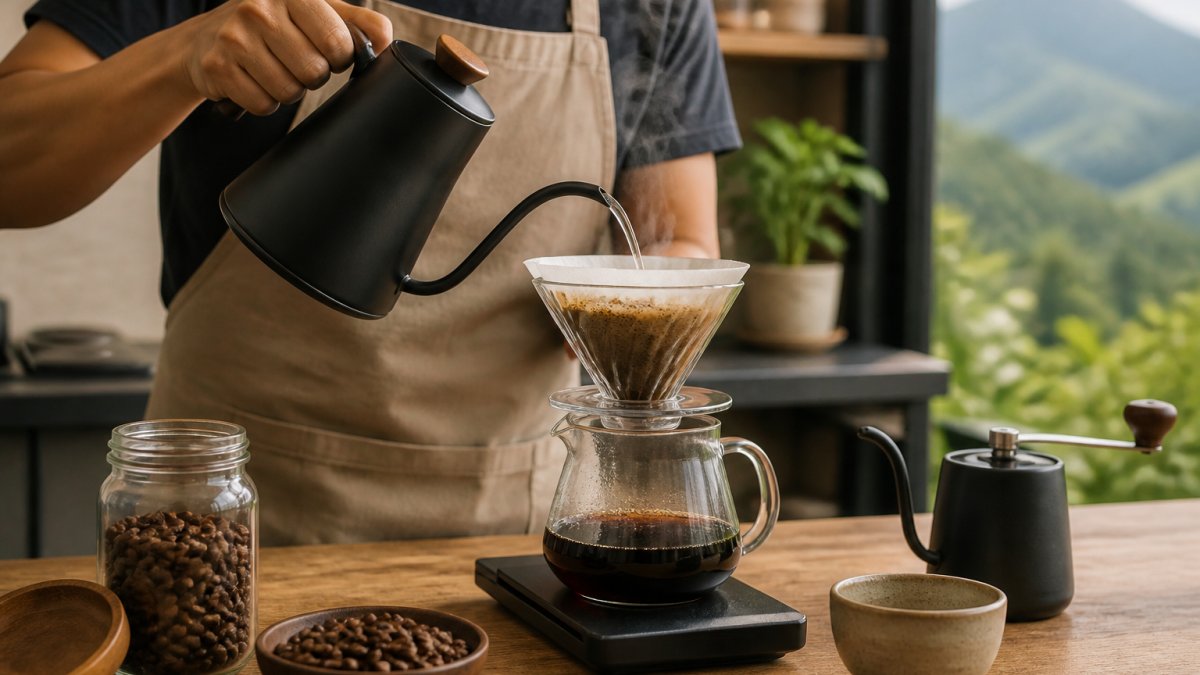
Total Time: 10 minutes Difficulty: Beginner
What You'll Need Before You Start
- Fresh whole-bean coffee, ideally roasted within the last few weeks
- A burr grinder set to medium
- A digital scale or measuring spoon
Step 2: Weigh your coffee. Use one to two tablespoons per six ounces of water.
Step 3: Grind to a medium setting. Match the texture of sand.
Step 4: Add a paper filter and rinse it. This removes paper taste and preheats the brewer.
Step 5: Start the brew and leave it alone. Do not stir the bed.
Expected Result: A smooth, balanced cup with a clean finish.
Water Temperature, Time, and Agitation: The Three Silent Bitterness Triggers
Three variables quietly push coffee toward bitterness, and most brewers never check them. Water temperature, brew time, and agitation work together and trade off against each other; get one wrong, and the cup suffers even if your grind and ratio are perfect.
Water Temperature: Why 195-205°F Is the Working Range
Water temperature controls how fast compounds dissolve. Below roughly 195°F, water struggles to pull sweetness and body out of the grounds, and the cup tastes sour and thin. Above roughly 205°F, it strips the harsh, drying compounds that read as bitter. The 195-205°F band keeps sweetness and bitterness in balance for most beans.
A few practical notes:
- Boiling water is not 212°F at the moment it hits the grounds. It cools as it travels from kettle to brewer. A gooseneck pour from a kettle just off boil often lands in range; a full rolling boil poured directly onto a fine grind usually does not.
- Dark roasts extract faster than light roasts. If your dark roast tastes bitter at 205°F, drop to 195-198°F before you change the grind.
- A cheap instant-read thermometer is the fastest upgrade here. Kettle thermometers and probe thermometers cost little and remove the guesswork.
Brew Time: Match the Clock to the Method
Brew time is method-specific. The same four-minute contact that is correct for drip will over-extract a fine pour-over and under-extract a French press.
- Drip machine: total cycle roughly 4-5 minutes from start to finish.
- Pour-over (V60, Kalita, Chemex): 2.5-4 minutes total, including a 30-45 second bloom.
- French press: 4 minutes steep, then press and pour immediately. Leaving the grounds in contact past 4-5 minutes keeps extracting and turns the cup bitter.
If your brew runs long, the grind is usually too fine. If it races through, the grind is too coarse. Time is a symptom as often as it is a cause.
Agitation: The Variable Most Brewers Never Think About
Agitation is any motion that moves water across the grounds, stirring, swirling, pouring from height, or a pump in a drip machine. More agitation means faster extraction, which is why a gentle spiral pour tastes different from the same recipe dumped in all at once.
- Skip agitation if your cup is bitter. Do not stir the bed, do not swirl the brewer, and pour gently.
- Add agitation if your cup is sour. A single gentle stir at the start of a French press steep, or a slow circular pour on a pour-over, can pull more sweetness out without tipping into bitterness.
How the Three Interact
These variables are not independent. A coarse grind with hot water and long contact can land in the same place as a fine grind with cooler water and short contact. That is why you change one variable at a time. The Specialty Coffee Association brewing standards publish a useful baseline for temperature and ratio that home brewers can calibrate against.
A Systematic Troubleshooting Chart for Smooth Coffee at Home
Use this chart to diagnose your cup in seconds. Find the taste, then apply the fix.
| Taste in the Cup | Likely Cause | The Fix |
|---|---|---|
| Bitter, dry, harsh | Grind too fine | Go one step coarser |
| Bitter and weak | Grind too fine, too little coffee | Coarser grind, check ratio |
| Sour, thin, salty | Grind too coarse | Go one step finer |
| Weak and watery | Too little coffee | Add grounds, keep grind |
| Flat and lifeless | Stale or old beans | Use fresher beans |
| Harsh and metallic | Water quality or dirty machine | Filter water, descale |
Work through one row at a time. Change only one thing per brew so you know what worked.
Water Quality, Bean Freshness, and Equipment Care: What Most Brewers Miss
The best grind and ratio in the world cannot save bad water or stale beans. These factors matter more than people expect, and the mechanism behind each one changes what you should actually do.
Water Quality and Mineral Composition
Brewed coffee is roughly 98% water, so water is most of the cup. Two numbers matter more than any others: total hardness and alkalinity.
- Hardness is mostly calcium and magnesium. Some is good. Magnesium in particular binds to coffee compounds and helps pull out sweetness and acidity. Water with almost no minerals, distilled or heavily reverse-osmosis filtered, tastes flat and lifeless, no matter how good the beans are.
- Alkalinity is the water's ability to buffer acid. High alkalinity mutes coffee's brightness and can make the cup taste dull or chalky. Very low alkalinity makes the cup taste sharp and thin.
- Chlorine and chloramine in municipal water add a medicinal, band-aid note that reads as harsh. A carbon filter removes chlorine; chloramine needs a filter rated for it.
A practical home approach: start with filtered tap water, not distilled. If your coffee tastes flat, the water may be too soft, a pinch of mineral blend or harder bottled water can help. If it tastes dull or chalky, the water is likely too alkaline, and a lower-mineral water will sharpen it.
Freshness, Storage, and Bean Age
Roast date is the single most useful number on a coffee bag, more useful than a "best by" date. Coffee is not as shelf-stable as most people assume.
- The first 3-7 days after roast are the degassing window. Beans release carbon dioxide, which can make pour-over beds foam and stall. Many brewers find the cup peaks around 7-21 days post-roast for filter coffee.
- After roughly 4-6 weeks, aroma compounds fade noticeably. The coffee does not become unsafe, but it loses the sweetness and complexity that make a smooth cup possible. No grind adjustment fully restores it.
- Oxygen, light, and heat are the three enemies. A one-way valve bag stored in a cool, dark cabinet is fine for short-term. For longer storage, an airtight container that pushes out oxygen slows the decline.
If your coffee tastes flat and lifeless, check the roast date before you touch the grinder. Stale beans and over-extraction can both taste bitter, but they need opposite fixes.
Equipment Cleaning and Descaling
Old coffee oils turn rancid and add a harsh, bitter edge no grind adjustment can fix. It is one of the cheapest upgrades to cup quality, and the one most home brewers skip.
- Daily: rinse the carafe, filter basket, and any reusable filter with hot water. Do not let oils sit overnight.
- Weekly: wash removable parts with mild dish soap. For a French press, disassemble the plunger and clean the mesh and the rod, not just the beaker.
- Monthly or per manufacturer guidance: descale the machine. Mineral scale from hard water builds up on heating elements and restricts flow, which slows the brew and pushes extraction toward bitterness. A descaling solution or a diluted white vinegar cycle, followed by two or three plain water cycles, is the standard home method.
A clean machine, fresh beans, and water that tastes good on its own will do more for smoothness than any single brewing tweak.
At Tinto Coffee Roasters, we seal every bag for freshness from roast day to brew day, and our USDA organic standards aligned sourcing keeps quality consistent. For a naturally smooth, low-acid option, our Dos Orígenes medium roast pairs Brazilian body with Mexican brightness, and it brews beautifully in a standard drip machine at 195-205°F.

Frequently Asked Questions
What cancels out bitterness in coffee?
A coarser grind and a shorter brew time are the two fastest fixes. Bitterness comes from over-extraction, so when you grind coarser, water passes through the grounds faster and pulls fewer harsh compounds. Lowering water temperature from a rolling boil to 195-205°F also helps. If the cup still tastes sharp, add a pinch of salt to your grounds before brewing; it blocks some bitterness receptors on your tongue.
What coffee-to-water ratio makes a smoother cup?
Start with 1 gram of coffee to 16 grams of water (about 1:16). For a standard 12-ounce drip mug, that means roughly 22 grams of coffee, or about 2 tablespoons. If the cup tastes weak or sour, tighten the ratio to 1:15. If it tastes bitter or dry, loosen it to 1:17. Small changes of one or two grams make a noticeable difference, so adjust one variable at a time.
Can coffee grind size make it taste bitter?
Yes. A grind that is too fine exposes more surface area to water, which speeds up extraction and pulls out bitter compounds. For drip coffee, aim for a medium grind that looks like coarse sand. If your drip machine uses a flat basket, go slightly coarser. If you use a cone filter, a medium grind works well. A burr grinder gives you consistent particles, which prevents both bitterness and sourness in the same cup.
Does brewing coffee for too long make it bitter?
It does. Every brewing method has a sweet spot. Drip coffee should finish between 4 and 5 minutes. French press needs a 4-minute steep, then an immediate press and pour. Cold brew can go 12 to 24 hours because cold water extracts slowly. If you leave coffee in contact with hot water past its window, the water keeps pulling bitter compounds. Set a timer and remove the grounds as soon as the brew finishes.
Bitterness is a solvable problem, not a fact of home brewing. Fix your grind, watch your temperature and time, and start with fresh beans. Tinto Coffee Roasters roasts to order within 48 hours, grades every small batch for quality and flavor consistency, and backs each order with a satisfaction guarantee. Shop Now and see how smooth your everyday cup can be.