

Table of Contents
- Why Small Batch Coffee Matters
- Understanding Coffee Brewing Ratios for One Cup
- Best Manual Coffee Makers for Small Batches
- Grind Size and Its Impact on Extraction
- Water Temperature and Bloom Time
- Troubleshooting Bitter Coffee and Other Flavor Issues
- Building Your Small Batch Brewing Setup
- Frequently Asked Questions
Last Updated: September 18, 2026
Why Small Batch Coffee Matters
The best ways to brew small batch coffee aren't just about making less. They're about making it right. When you brew only what you'll drink today, every variable matters more. Water temperature, grind size, brew time, they all shift the flavor profile in ways you'll actually notice.
The best ways to brew small batch coffee start with understanding that small batches demand precision. You're not hiding behind volume. A single cup brewed poorly tastes bitter. That same cup brewed well tastes like what it actually is: Colombian arabica with notes of chocolate and caramel, smooth enough to drink black.
Small batch brewing also means fresher coffee. When you buy whole beans roasted to order and brew only what you need, you're working with coffee at its peak. The aroma stays. The sweetness stays. The clarity of the extraction comes through.
Understanding Coffee Brewing Ratios for One Cup
The foundation of small batch brewing is the coffee-to-water ratio. Get this right and everything else becomes easier.
The 1:16 Ratio Standard
The 1:16 ratio is the starting point for most manual brewing. This means 1 gram of coffee to 16 grams of water. In practical terms, that's roughly 15 grams of coffee (about a tablespoon) to 240 milliliters of water (8 fluid ounces).
This ratio produces a balanced cup. Not too strong. Not too weak. It's the ratio that works across pour-overs, AeroPress, and French press methods.
To measure accurately, use a kitchen scale. Eyeballing it works sometimes. A scale works every time. Weigh your coffee first. Then add water until you hit the target weight.
The 1:16 standard exists because it's been tested thousands of times. It's the ratio that maximizes extraction without pushing into bitterness.
Adjusting for Strength and Flavor
The 1:16 ratio is a starting point, not a law. Adjust it based on what you actually want.
For a stronger cup, move toward 1:14 or 1:15. This uses more coffee relative to water. The extraction becomes more intense. You get more body, more mouthfeel, more presence.
For a lighter cup, move toward 1:17 or 1:18. This uses less coffee relative to water. The result is cleaner, brighter, more delicate. The flavor profile becomes more about the origin's natural sweetness.
Your preference matters more than any formula. Start at 1:16. Brew it. Taste it. If you want it stronger, add a gram more coffee next time. If you want it lighter, reduce by a gram.
| Ratio | Strength | Best For | Flavor Profile |
|---|---|---|---|
| 1:14 | Strong | Bold preference | Full body, intense |
| 1:16 | Balanced | Most people | Clean, smooth |
| 1:18 | Light | Bright preference | Delicate, sweet |
Best Manual Coffee Makers for Small Batches
Manual brewing methods give you control. They're also simple enough for a weekday morning.
Pour-Over Brewing
Pour-over is the most forgiving manual method for small batches. You pour hot water over grounds held in a filter. Gravity does the work. The result is clean and bright.
The technique matters more than the equipment. A basic ceramic dripper costs under ten dollars. An expensive one costs fifty. Both produce excellent coffee if you use the right technique.
Start with a bloom. Pour just enough hot water to saturate the grounds. Wait 30 seconds. This lets CO2 escape and lets water penetrate the coffee evenly. Then pour the rest of the water slowly, in circles, over 3 to 4 minutes total.
Pour-over works best with a standard or medium-coarse grind. Paper filters are common and produce clarity. Metal mesh filters work too but allow more sediment through.
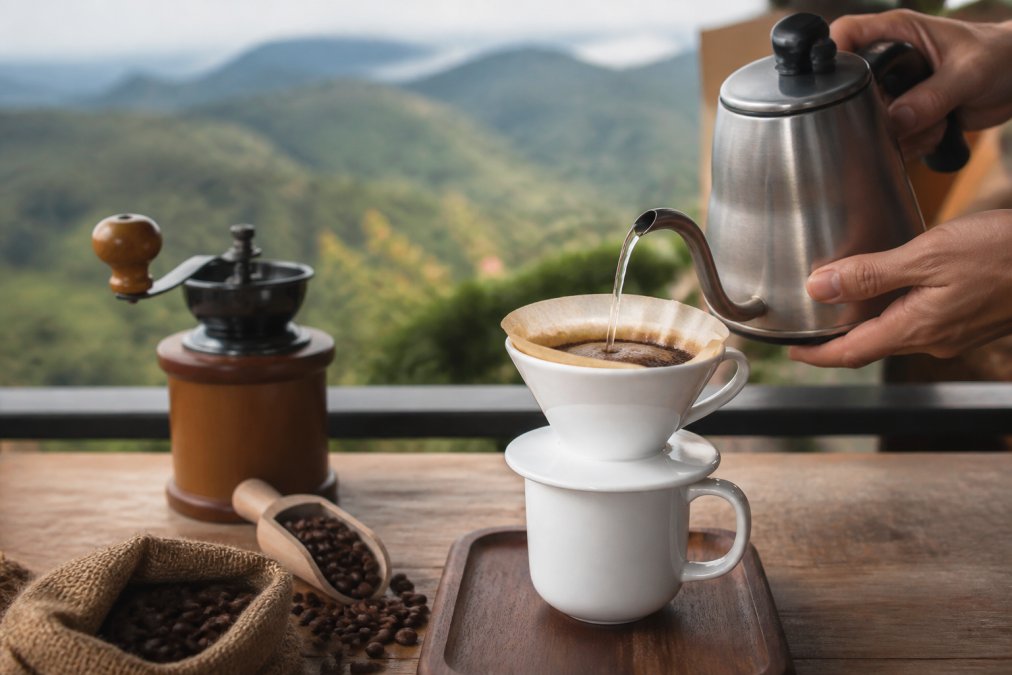
The water temperature should be 195 to 205 degrees Fahrenheit. Hotter extracts more. Cooler extracts less. This range hits the sweet spot for most beans.
French Press Immersion
French press brewing works differently from pour-over. Instead of water flowing through grounds, grounds steep in water. This is immersion brewing.
Add coarsely ground coffee to the pot. Pour hot water over it. Stir gently. Let it sit for 4 minutes. Press the plunger down slowly.
The result is full-bodied and rich. More oils stay in the cup because there's no paper filter. The mouthfeel is thicker. The flavor is bolder.
French press demands coarse grind. If your grind is too fine, sediment clouds the cup and the coffee tastes gritty. Too coarse and the extraction is weak and sour.
The 1:16 ratio works here too. For a single cup, that's about 15 grams of coffee to 240 milliliters of water.
AeroPress and Moka Pot Options
AeroPress is a hybrid. It uses immersion like French press but adds pressure like espresso. The result is clean and strong.
Add medium-fine ground coffee to the chamber. Pour hot water. Stir. Wait 1 to 2 minutes. Press down steadily. The whole process takes about 3 minutes.
AeroPress produces less than 2 ounces of concentrated coffee. Many people add hot water after pressing to dilute it to full cup strength. This method gives you control over both strength and volume.
Moka pot is stovetop brewing. It forces hot water through grounds using steam pressure. The result tastes closer to espresso than to drip coffee.
Fill the bottom chamber with water. Add finely ground coffee to the filter basket. Screw on the top chamber. Heat on medium until you hear a hissing sound. The coffee is done.
Moka pot requires medium-fine grind and careful heat management. Too much heat and the coffee tastes burnt. Too little and the extraction is incomplete.
Grind Size and Its Impact on Extraction
Grind size controls how fast water moves through coffee. Finer grinds slow water down. Coarser grinds speed it up.
This matters because extraction is about time. The longer water stays in contact with grounds, the more it dissolves. Too little contact and the coffee tastes sour and thin. Too much and it tastes bitter and harsh.
Pour-over needs standard grind. Water flows through in 3 to 4 minutes. This is the Goldilocks zone for extraction.
French press needs coarse grind. The 4-minute steep time needs coarser particles or over-extraction happens fast.
AeroPress works with medium-fine grind. The pressure and shorter brew time mean finer particles extract evenly without becoming bitter.
Cold brew needs coarse grind. The 12 to 24 hour steep time is so long that even coarse particles extract fully. Fine grind would over-extract and taste harsh.
A burr grinder gives you consistency. Blade grinders produce uneven particle sizes. Some grounds over-extract while others under-extract. The result tastes confused.
Water Temperature and Bloom Time
Water temperature is the second control lever for extraction. Hotter water extracts faster. Cooler water extracts slower.
The ideal range is 195 to 205 degrees Fahrenheit. This is hot enough to extract the flavors you want. It's cool enough to avoid pulling out the harsh, bitter compounds that live deeper in the bean.
Boiling water (212 degrees) extracts too aggressively. The coffee tastes burnt. Room temperature water extracts too slowly. The coffee tastes sour and thin.
If you don't have a thermometer, boil water and wait 30 seconds before pouring. This cools it to roughly the right temperature.
Bloom time is the first 30 seconds of brewing. You pour just enough water to saturate the grounds. You wait. This lets CO2 trapped in the beans escape. It also lets water begin penetrating the coffee evenly.
Without bloom time, the first water you pour finds the easiest path through the grounds.
Troubleshooting Bitter Coffee and Other Flavor Issues
When small batch coffee tastes wrong, the problem is usually extraction.
Identifying Over-Extraction
Over-extracted coffee tastes bitter, harsh, and astringent. It coats your mouth. Your first instinct is to add milk or sugar.
- Grind too fine
- Water too hot
- Brew time too long
- Agitation too aggressive
Fixing Under-Extraction and Sourness
Under-extracted coffee tastes sour, thin, and weak. It lacks body. It tastes like flavored water.
- Grind too coarse
- Water too cool
- Brew time too short
- Insufficient agitation
Sediment and Clarity Issues
Sediment clouds your cup and creates a gritty texture. It comes from fine particles in your coffee.
Building Your Small Batch Brewing Setup
You don't need much to brew excellent small batch coffee. You need hot water, ground coffee, and a method.
Frequently Asked Questions
What is the best water-to-coffee ratio for small batch coffee?
The standard ratio is 1:16 (one part coffee to 16 parts water by weight). For a single 8-ounce cup, use 0.5 ounces (about 14 grams) of coffee. Adjust to 1:15 for stronger coffee or 1:17 for lighter brews. Use a kitchen scale for accuracy, measuring by tablespoons varies too much. Most small batch brewing methods work best within this range, though immersion methods like French press can tolerate slightly different ratios depending on steep time.
How does grind size affect small batch coffee flavor?
Grind size controls how fast water extracts flavor compounds from the grounds. Finer grinds (espresso, pour-over) expose more surface area and extract faster, risking bitterness if over-extracted. Coarser grinds (French press, cold brew) extract slower, which prevents bitterness but can taste sour if under-extracted. Match your grind to your brewing method: standard for drip, coarse for French press, medium-fine for pour-over. A burr grinder gives you consistency that blade grinders cannot match.
Why does my small batch coffee taste bitter?
Bitter coffee usually signals over-extraction, where hot water pulls too many compounds from the grounds. Check three things: water temperature (should be 195-205°F, not boiling), brew time (follow your method's recommended time), and grind size (too fine extracts too fast). For pour-over, reduce brew time by 30 seconds. For French press, press and pour immediately at 4 minutes instead of letting it sit. If using pre-ground coffee, switch to whole bean, pre-ground loses freshness and extracts unevenly.
What brewing method works best for fresh, small-batch roasted coffee?
Pour-over and AeroPress highlight the clarity and flavor profile of freshly roasted small-batch beans better than drip machines. Pour-over lets you control bloom time (30 seconds) and total brew time (3-4 minutes), which brings out the brightness and acidity you pay for with premium roasts. AeroPress offers similar control in a portable format. If you prefer convenience, a drip machine works fine, use a standard grind and fresh water at 195-205°F. Avoid re-heating or letting brewed coffee sit more than 30 minutes.