

Last Updated: October 25, 2026
Quick Summary
To descale a coffee pod machine, add a manufacturer-approved descaler to the reservoir, run the machine's descaling cycle, then rinse with clean water two to three times until the water runs clear and tastes neutral. Expect the job to take about 30 to 45 minutes including rinse cycles.
- Most pod machine makers recommend descaling every 3 to 4 months with regular use.
- With hard water and daily use, descale your machine every 1 to 2 months.
- Never run a second descaling cycle back-to-back with fresh descaler.
- If you use vinegar, mix equal parts white vinegar and water, then rinse until the smell is gone.
- A descale light that stays on usually means the cycle did not fully complete.
Table of Contents
- Why Your Coffee Pod Machine Needs Descaling
- Signs It's Time to Descale Your Pod Coffee Maker
- How Often to Descale a Coffee Machine
- Choosing a Coffee Machine Descaling Solution
- Step-by-Step: How to Descale a Coffee Pod Machine
- Can You Use Vinegar to Descale a Coffee Machine?
- Coffee Machine Descale Light Won't Turn Off: What to Try
- Keep Your Pods Tasting Fresh Between Descales
- Frequently Asked Questions
Why Your Coffee Pod Machine Needs Descaling
Learning how to descale a coffee pod machine comes down to one simple fact: heat and water leave minerals behind.
The result of skipping it is not subtle.
A pod coffee maker is especially prone to this because the water path is narrow.
Here is the good news: descaling is a routine maintenance task, not a repair.
Keurig's official descaling instructions show the process is button-driven and model-specific, which matters later.
Signs It's Time to Descale Your Pod Coffee Maker
The clearest sign is a descale light or warning message on the machine. Manufacturers set these based on cycle counts, so trust them when they appear. Beyond the light, watch for slower water flow, a weaker brew, or coffee that tastes off even with fresh pods.
Other signals that mineral buildup has taken hold:
- The brew cycle takes longer than it used to
- Water sputters or steams more than normal
- The machine sounds louder during a brew
If you notice two or more of these, descale now rather than waiting for the light. A common mistake is assuming a slow brew means a bad pod. Usually, it means scale.
How Often to Descale a Coffee Machine
Most pod machine makers recommend descaling every 3 to 4 months with regular use. If you brew several cups a day, lean toward the shorter end. If you have hard water, descale more often, since minerals build up faster.
Water hardness is the variable most people ignore. Water with high mineral content leaves scale quickly, so a machine on hard water may need descaling every month or two. Soft water stretches the interval.
A simple rule we recommend:
| Your Situation | Descale Every |
|---|---|
| Soft water, 1-2 cups a day | 4 months |
| Average water, daily use | 3 months |
| Hard water, daily use | 1-2 months |
| Light use, soft water | 4-6 months |
Check your water supplier's hardness report to pick your interval. Also follow the manufacturer's schedule in the manual, since some machines track their own cycles.
Choosing a Coffee Machine Descaling Solution
The best coffee machine descaling solution is the one made or approved for your model. Manufacturer-branded descalers are formulated to be safe on the machine's internal parts. That is the safest starting point, and it is also the fastest way to avoid a voided warranty or a residue problem.
Store-bought descalers come in two main types:
- Citric-acid based: gentle, widely compatible, good for routine care. It rinses relatively clean but can be slow on heavy scale.
- Proprietary blends: made for a specific brand, with clear dosing instructions. These often include a color indicator or a specific concentration that matches the machine's cycle length.
Avoid harsh or industrial cleaners. They can damage seals and leave residue. Never mix descalers, and never run a cleaner not meant for coffee machines.
When Vinegar Is the Wrong Choice
White vinegar is a mild acid that breaks down scale, and many people use it as a DIY option. The catch is that some manufacturers advise against it, because the smell lingers and it may not suit certain internal parts. Vinegar is a poor fit in three common situations:
- Your manual explicitly says not to use it. The manual takes precedence over any online tip.
- Your machine has aluminum or silicone components that are sensitive to acetic acid.
- You cannot commit to a long rinse. Vinegar odor can persist for several brews if the flush is rushed.
If you go the vinegar route, mix equal parts white vinegar and water, run it through the descaling cycle, and rinse thoroughly several times until the smell is gone. When in doubt, use a manufacturer-approved descaler instead, since it is formulated for the machine and rinses cleaner.
How to Pick a Compatible Descaler
Use this checklist before you buy:
- Check the manual for an approved descaler name or a stated active ingredient.
- Match the dose to the reservoir size, not to the bottle label alone.
- Confirm the descaler is labeled for coffee machines, not kettles or dishwashers.
- Buy a size you can use within the recommended shelf life so the concentration stays consistent.
Watch out: using the wrong concentration of descaler can leave residue that affects taste. Measure per the label, not by eye.
If you want to keep your whole coffee routine dialed in, our guide to the everyday coffee experience covers maintenance and brewing in one place.
K-Cups Coffee Flavored & Nonflavored Organic Supreme Finest Premium American →
Step-by-Step: How to Descale a Coffee Pod Machine
The general process is the same across most pod machines: prep, run the descaling cycle, then rinse thoroughly. Exact button presses vary by model, so keep your manual nearby.
| Machine type | How descaling starts | Typical cycle time | Rinse requirement |
|---|---|---|---|
| Keurig-style pod brewer | Descale button or button combo, often with a light | 30-45 minutes including rinse | Full reservoir rinse, then 2-3 brew cycles |
| Nespresso-style espresso pod machine | Button hold sequence, sometimes with a lever position | 20-30 minutes plus rinse | Rinse tank and run a full rinse cycle twice |
| Combination pod and drip machine | Descaling mode on the pod side, separate drip cycle | 45-60 minutes | Rinse both water paths |
| Budget or no-name pod machine | Usually a manual brew cycle with descaler in the tank | 30 minutes plus rinse | 3-4 plain water cycles |
Step 1: Prep the Machine and Clear the Pod Holder
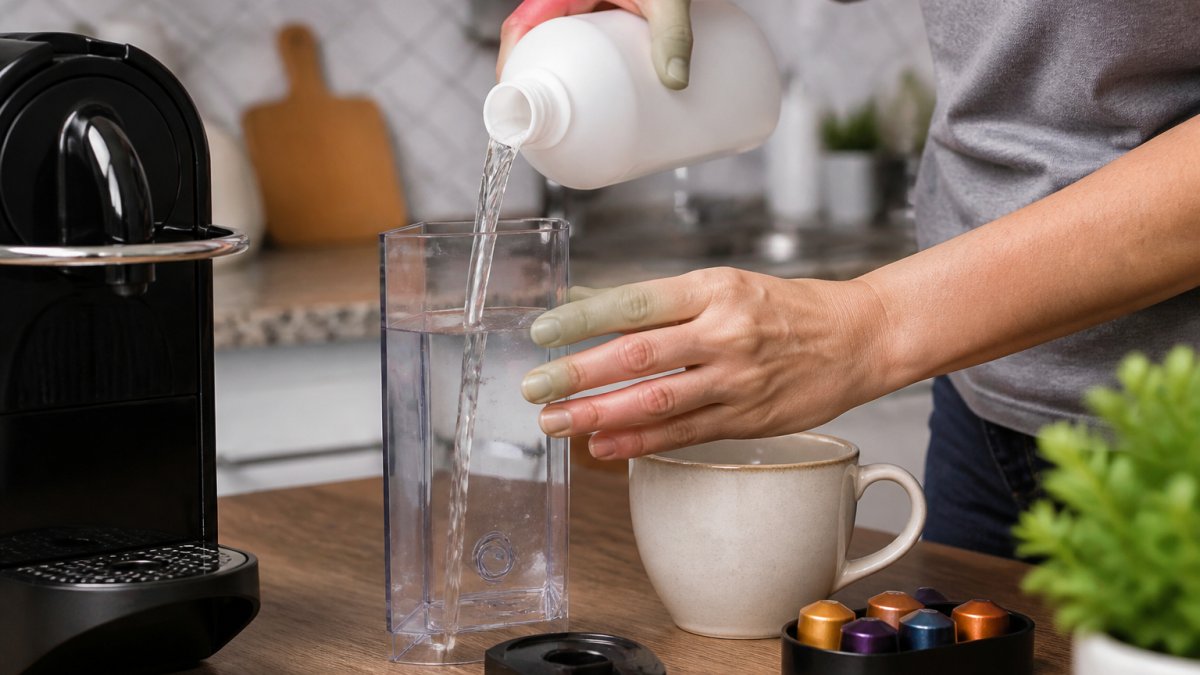
Start with a cool machine and unplug it if the manual says to. Remove any pod from the pod holder and empty the drip tray. Pull out the water reservoir and dump the old water.
Wash the reservoir and pod holder with warm, soapy water, then rinse well. Fill the reservoir with fresh water to the descale line, or the amount your manual specifies.
Step 2: Mix the Solution and Start the Descaling Cycle
Add the descaler to the reservoir per the label, then top with water if needed. Put a large mug or container under the spout to catch the solution.
Now start the descaling mode. On many machines this means holding a button combination, which is why model-specific instructions matter. Nespresso's machine assistance guides are a good example of brand-specific steps.
Let the machine run its descaling cycle. Expect 30 to 45 minutes including wait time and rinse cycles, based on a coffee machine cleaning checklist from PureHQ Filters.
Step 3: Rinse and Flush Until the Water Runs Clear
Rinse the reservoir and refill it with clean water. Run a full rinse cycle, or brew plain water through the machine, and dump the catch container. Repeat this rinse two to three times.
The job is done when the water runs clear and tastes neutral. Once you are happy, brew your first cup, and get the water to coffee ratio right so it tastes as good as it should.
Step 4: Reset the Descale Light and Confirm Normal Operation
Many machines keep the descale light on until you complete a specific reset step after the final rinse. Check the manual for the reset sequence, which is often a button hold of five to ten seconds. After resetting, run one plain water brew and check three things: the flow is steady, the water tastes neutral, and no warning light returns.
Can You Use Vinegar to Descale a Coffee Machine?
You can use white vinegar to descale a coffee machine, but check your manual first. Vinegar is a mild acid that breaks down scale, and many people use it as a DIY option.
If you go the vinegar route:
- Mix equal parts white vinegar and water
- Run it through the descaling cycle
- Rinse thoroughly, several times, until the smell is gone
The vinegar smell can hang around for a few brews. A full flush usually clears it. When in doubt, use a manufacturer-approved descaler instead, since it is formulated for the machine and rinses cleaner.
Coffee Machine Descale Light Won't Turn Off: What to Try
A descale light that stays on usually means the descaling cycle did not fully complete. Many machines require you to run the entire cycle, including the rinse, before the light resets.
Try these fixes in order:
- Re-run the full descaling and rinse cycle without interruption
- Check the reservoir is filled to the correct line
- Make sure the pod holder and drip tray are seated properly
- Follow the exact button sequence in your manual for resetting the light
- Unplug the machine for a minute, then restart
If the light still will not clear after a complete cycle, check the manual's troubleshooting section. On some models, the reset is a specific button hold, and missing it is the usual culprit.
Keep Your Pods Tasting Fresh Between Descales
A clean machine deserves fresh coffee. Between descaling cycles, store your pods away from heat and moisture so they stay at their best. If you brew whole bean coffee too, our guide to storing whole bean coffee covers the details.
For pod machines, we roast in small batches and seal each pod for freshness. Our "The Sophia" Colombian Pods are single-origin, oxygen-sealed, and made for full, even extraction. If you like variety, the K-Cups collection spans roasts from breakfast blend to hazelnut.


Best for: anyone who wants fresh, small-batch coffee that works in a single-serve machine.
Frequently Asked Questions
How long does it take to descale a coffee pod machine?
Plan for roughly 30 to 45 minutes, based on a coffee-machine cleaning checklist from PureHQ Filters. Most of that is wait time while the descaling solution sits in the tank and works on the limescale, plus the rinse cycles afterward. The active steps, like filling the water reservoir and starting the descaling mode, take only a few minutes. Set a timer and use the wait to rinse the pod holder and drip tray.
Can I use vinegar to descale my coffee pod machine?
White vinegar mixed with equal parts water is a common DIY option, but check your manufacturer's instructions first. Some pod machine makers advise against vinegar because repeated use can affect rubber seals and leave an odor. If you do use it, run several clean-water rinse cycles afterward so your next cup doesn't taste like vinegar. A purpose-made descaling solution is the safer default for most models.
What should I do if my coffee machine descale light won't turn off?
First, confirm you completed the full descaling cycle, including every rinse, because many machines only reset after the final flush. If the light stays on, unplug the machine for a minute, plug it back in, and repeat the rinse step with clean water. Check your model's manual for a specific reset button sequence, since procedures differ between brands. If it still won't clear, contact the manufacturer's support line.
How often should I descale a coffee pod machine?
Every 3 to 4 months works for most households, but water hardness changes that. If your tap water is hard or you brew several cups a day, descale closer to every 2 months. Soft water and light use can stretch it to twice a year. Many pod machines also have a descale indicator light that tells you when mineral buildup has reached the point where it's time, so trust that signal alongside a calendar reminder.
Descaling keeps your machine running and your coffee tasting right. Once you have the routine down, the real upgrade is what goes in the pod. At Tinto Coffee Roasters, we roast to order within 48 hours, source in small batches, and grade every lot for quality and flavor consistency, backed by a satisfaction guarantee. Get started with Tinto Coffee Roasters and taste what fresh, small-batch Colombian coffee does for your daily cup.
