

Table of Contents
- What the Golden Ratio Actually Means for Black Coffee
- How to Calculate Your Coffee-to-Water Ratio in Grams
- Using a Coffee Brewing Ratio Calculator
- Ratios for Every Brewing Method: Pour-Over, French Press, Drip, and Cold Brew
- Best Coffee Beans for Drip Machines (and What Ratio Works Best)
- How to Brew Smooth Black Coffee: Adjusting for Roast, Grind, and Water Temperature
- Common Ratio Mistakes and How to Fix Them
- Frequently Asked Questions
Last Updated: October 2, 2026
What the Golden Ratio Actually Means for Black Coffee
The best water to coffee ratio for black coffee sits between 1:15 and 1:18, meaning one part coffee to 15-18 parts water by weight. That range is a starting point, not a law. This guide from Tinto Coffee Roasters breaks down exactly how to dial in your cup.
Here's what most brewing guides get wrong: they hand you a single number and walk away. But your beans, your grind, and your brewer all shift the target.
Get the ratio right and black coffee tastes sweet, clean, and balanced. Get it wrong and you get sour or bitter water. Below, we'll show you exactly how to calculate, adjust, and troubleshoot your ratio for any method.
Why 1:15 to 1:18 Is the Starting Point, Not the Rule
Think of 1:15 to 1:18 as the center of the dial, not the whole dial. The Specialty Coffee Association's brewing standards treat this range as the baseline for balanced extraction.
Move toward 1:15 for a bolder, heavier cup. Move toward 1:18 for something lighter and brighter. Both are correct. They just make different coffee.
The real variable is your taste. Start at 1:16, then adjust one gram at a time until the cup tastes right to you.
How to Calculate Your Coffee-to-Water Ratio in Grams
Calculating your coffee ratio in grams takes one formula: divide your water weight by your target ratio. For a 1:16 ratio and 320 grams of water, you need 20 grams of coffee.
Here's the simple math:
- Water weight ÷ ratio number = coffee weight
- 320g water ÷ 16 = 20g coffee
- 500g water ÷ 16 = 31g coffee
That's it. No app required.
Grams vs. Scoops: Why a Digital Scale Changes Everything
A scoop is a guess. A gram is a fact.
Scoops vary by grind, bean density, and how you pack them. Two tablespoons of fine grind can weigh nearly double two tablespoons of coarse grind. That swing wrecks consistency.
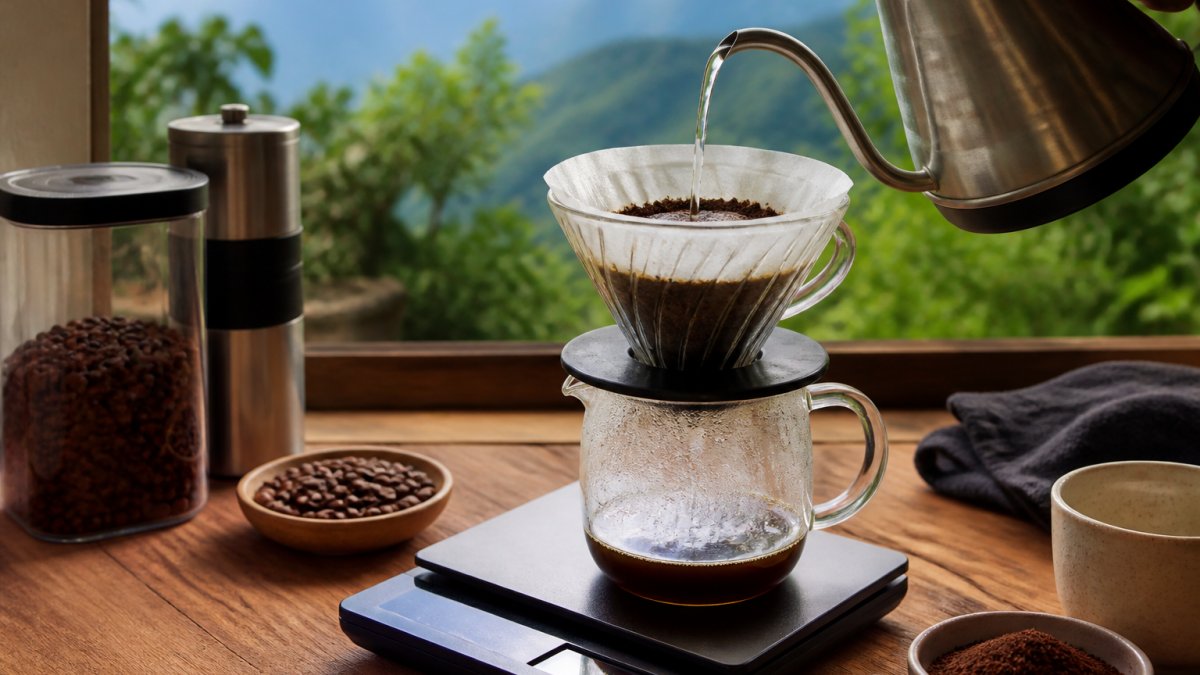
A basic digital scale costs little and fixes the problem forever. Weigh your beans, weigh your water, and repeat the same cup every morning.
Using a Coffee Brewing Ratio Calculator
A coffee brewing ratio calculator does the math for you: enter your water amount and target ratio, and it returns the exact coffee weight. Most free calculators online handle this in seconds.
Every calculator runs the same formula from the section above: water weight divided by the ratio number equals coffee weight. When you enter 500 grams of water and a 1:16 ratio, the calculator divides 500 by 16 and returns 31.3 grams of coffee.
Scaling a Recipe Without Breaking the Balance
Use a calculator when you are scaling a recipe up or down. The ratio stays fixed; only the totals change. Here is how that plays out in practice:
- Single mug (250g water at 1:16): 15.6g coffee
- Two mugs (500g water at 1:16): 31.3g coffee
- Full carafe (1,000g water at 1:16): 62.5g coffee
- Cold brew concentrate (500g water at 1:5): 100g coffee
Notice the ratio never moves, only the multiplier. That is the point of a calculator: it removes arithmetic errors when you jump from one cup to a full batch.
Going Beyond Weight: TDS and Refractometer Readings
Weight ratios tell you what you put in. They do not tell you what you got out. That is where Total Dissolved Solids (TDS) comes in.
TDS measures the percentage of dissolved coffee solids in your finished cup, and a refractometer is the handheld tool that reads it. A common target range for black coffee is roughly 1.15% to 1.45% TDS, though the ideal number depends on your brew method and personal taste. Most practitioners find that a cup reading near 1.3% tastes balanced, while readings below 1.15% taste weak and above 1.45% taste heavy or muddy.
Here is how TDS connects back to your ratio:
- If your ratio is correct but the cup tastes thin, your extraction may be low, try a finer grind or slightly hotter water.
- If the cup tastes bitter and harsh, your extraction may be too high, coarsen the grind or shorten the brew time.
- If the cup tastes right but weak, increase the coffee dose (lower the ratio number).
- If the cup tastes right but too strong, decrease the dose (raise the ratio number).
A refractometer is not required to make good coffee, but it turns guesswork into measurement. For home brewers chasing consistency, it is the logical next step after a digital scale.
A Quick Way to Check Your Calculator
If you ever doubt a calculator's output, run the math yourself. Divide your water weight by your ratio number. If the calculator returns a different coffee weight, one of your inputs is wrong, usually the water amount, because machine markings rarely match actual volume.
Ratios for Every Brewing Method: Pour-Over, French Press, Drip, and Cold Brew
Each brewing method wants its own ratio because each one extracts differently. Immersion brewing, like a French press, and percolation, like a pour-over, pull flavor out of the grounds at different speeds.
| Method | Coffee-to-Water Ratio | Grind Size | Brew Time |
|---|---|---|---|
| Pour-Over | 1:15 to 1:17 | Medium-fine | 3-4 min |
| French Press | 1:12 to 1:15 | Coarse | 4 min steep |
| Drip | 1:16 to 1:18 | Medium | 4-6 min |
| Cold Brew | 1:4 to 1:8 | Coarse | 12-24 hrs |
Cold brew uses a much stronger ratio because you dilute it after steeping. A 1:4 concentrate gets cut with water or milk before you drink it.
Best Coffee Beans for Drip Machines (and What Ratio Works Best)
The best coffee beans for drip machines are medium-roast, small-batch beans with a consistent grind. Drip machines reward balance, so a medium roast at 1:16 to 1:18 hits the sweet spot. But the deeper story is that roast level changes how soluble your coffee is, and that changes the ratio you should use.
Why Roast Level Changes the Ratio
Roasting drives moisture out of the bean and develops the sugars and acids inside it. The longer and darker the roast, the more porous and soluble the bean becomes.
- Light roasts are denser and less soluble. They need more coffee or a finer grind to reach full extraction. Push them toward 1:15 or 1:16.
- Medium roasts sit in the middle. The standard 1:16 to 1:18 range works well, and they tolerate small ratio errors.
- Dark roasts are highly soluble and extract fast. Push them toward 1:17 or 1:18 to avoid pulling bitter compounds. Some brewers go as high as 1:18 with a coarser grind.
This is the nuance most ratio charts skip. They hand you one number for 'drip' and ignore that a light Ethiopian and a dark Sumatra want different treatment in the same machine.
Matching Beans to Your Drip Machine
Drip machines brew at a fixed temperature and a fixed flow rate, so you cannot adjust much beyond dose and grind. That makes bean choice matter more.
- Medium roasts are the safest bet. They extract evenly across the machine's brew cycle and rarely turn bitter.
- Dark roasts can turn bitter fast in a drip brewer because the machine keeps the water hot for the full cycle. If you brew dark, use a coarser grind and a higher ratio (more water).
- Light roasts sometimes taste sour in a drip machine because the brew temperature runs cool. If your machine brews below 195°F, a light roast may never fully extract. Compensate with a finer grind or a longer brew time.
A medium roast holds up best for most drip setups because it forgives the variables you cannot control.
Freshness Beats Everything Else
Bean quality matters more than any gadget. Fresh beans, roasted recently and ground just before brewing, give you a smoother black cup. Coffee stales quickly once roasted, most of the flavor loss happens in the first two to three weeks. Buying from a roaster that ships soon after roasting keeps you inside that window.
For drip machines, use a standard medium grind. A common starting point is 1 to 2 tablespoons of coffee per 6 ounces of water, but weigh it if you can, a scale removes the guesswork. Brew at 195-205°F, the range the National Coffee Association's brewing guidance points to for proper extraction.
How to Brew Smooth Black Coffee: Adjusting for Roast, Grind, and Water Temperature
Smooth black coffee comes from matching your ratio to your roast, grind, and water temperature. Change one and the others shift too.
Water temperature matters more than most people think. The National Coffee Association's brewing guidance points to 195-205°F as the target range. Below that, you under-extract and get sour notes. Above it, you scorch the grounds.
Altitude changes things too. At high elevation, water boils at a lower temperature. If you live above 3,000 feet, your kettle may never reach 205°F.
Roast level also drives ratio. Dark roasts are more soluble, so they extract faster. Push them toward 1:17 or 1:18.
Common Ratio Mistakes and How to Fix Them
Most ratio problems come down to a few repeatable errors. Fix these and your black coffee improves overnight.
- Using scoops instead of grams: Switch to a scale. Scoops cause wild swings in strength.
- Ignoring water weight: Measure the water you actually pour, not the line on the machine.
- Brewing too hot: Let your kettle rest 30 seconds after boiling before you pour.
- Never adjusting: If a cup tastes off, change one variable at a time. One gram or one degree.
- Stale beans: Old coffee tastes flat no matter the ratio. Fresh beans fix more than math does.
For a deeper look at how dissolved solids shape flavor, the U.S. Department of Agriculture's coffee research offers background on bean composition and extraction.
Frequently Asked Questions
What is the ideal water to coffee ratio for black coffee brewing?
The Specialty Coffee Association's gold standard is 1:18, meaning 1 gram of coffee to 18 grams of water. For a standard 8-ounce cup (237 ml), that's roughly 13 grams of coffee. If you prefer a stronger cup, tighten to 1:15. For a lighter, tea-like cup, loosen to 1:17. Start at 1:16 and adjust by taste.
Is it 1 or 2 tablespoons of coffee per cup?
One tablespoon of ground coffee weighs about 5 to 6 grams, so 2 tablespoons (10 to 12 grams) is closer to the gold standard for an 8-ounce cup. One tablespoon will taste weak. A digital scale removes the guesswork entirely, since tablespoon volume varies with grind size and how you scoop.
Does the roast level change the recommended coffee-to-water ratio?
Yes. Dark roasts are more soluble and extract faster, so they can taste bitter at 1:15. Try loosening to 1:17 or 1:18. Light roasts are denser and less soluble, so they often need a tighter ratio like 1:15 or 1:16 to draw out sweetness. Adjust one variable at a time and taste.
How do I measure coffee-to-water ratio without a scale?
Use the 1 to 2 tablespoon rule per 6 ounces of water as a starting point, then adjust by taste. For a coffee brewing ratio calculator approach without equipment, remember that 1 tablespoon is roughly 5 grams. It works in a pinch, but a $15 digital scale is the single biggest upgrade for consistent black coffee.
Getting black coffee right comes down to one habit: measure, taste, adjust. Most people never weigh their coffee, so they never fix what's wrong. Tinto Coffee Roasters makes that easier with small-batch beans roasted to order, sealed for freshness, and graded for flavor consistency. Start with the Tinto Coffee Bag at a 1:16 ratio, or grab "The Sophia" Colombian Pods if you want single-serve convenience without giving up quality. Shop now and taste what a proper ratio does for your morning cup.