

Table of Contents
- What Direct Trade Colombian Coffee Actually Means
- Direct Trade vs Fair Trade Coffee: Key Differences
- The Impact of Direct Trade on Coffee Farmers
- How Direct Trade Improves Flavor and Freshness
- Colombian Terroir and Varietals: What Direct Trade Preserves
- Logistics, Verification, and Environmental Impact
- Frequently Asked Questions
Last Updated: September 15, 2026
What Direct Trade Colombian Coffee Actually Means
Direct trade Colombian coffee is a sourcing model where roasters buy straight from farms or cooperatives in Colombia, skipping the export intermediaries and commodity auctions that set standard market prices. This guide from Tinto Coffee Roasters covers the benefits of direct trade Colombian coffee for farmers, roasters, and the cup in front of you.

The model is not a single certification. It is a relationship, and that distinction matters more than most buyers realize. Direct trade agreements typically involve multi-year commitments, farm-gate pricing negotiated above commodity market rates, and roasters who visit the farms they buy from. USDA Foreign Agricultural Service coffee market reports track how these private arrangements sit alongside the broader commodity system.
What most guides get wrong is treating direct trade as a label. It is a practice, and practices vary widely by roaster.
Direct Trade vs Fair Trade Coffee: Key Differences
Fair Trade is a third-party certification with audited standards and a guaranteed minimum price floor. Direct trade is a business relationship, usually unregulated, where terms are set between roaster and producer.
The practical differences come down to who enforces what:
| Feature | Fair Trade | Direct Trade |
|---|---|---|
| Oversight | Third-party certification body | Roaster-farmer relationship |
| Price mechanism | Guaranteed minimum floor | Negotiated above market |
| Verification | Formal audits | Farm visits, receipts, transparency reports |
| Flexibility | Standards-based | Contract-specific |
| Traceability | Cooperative-level | Often single-farm |
Fair Trade's strength is accountability through audits. Its limitation is that certification costs and cooperative-level pooling can dilute the benefit to individual growers. Direct trade's strength is flexibility and traceability. Its weakness is that nothing forces a roaster to be honest about the terms.
That is the trade-off nobody advertises: certification guarantees process, relationships guarantee nothing except what both sides choose to document.
The Impact of Direct Trade on Coffee Farmers
The benefits of direct trade Colombian coffee are at heart economic: pay farmers more, and they can invest in their land, their processing, and their families. But the size of that promise depends on where in Colombia the farm sits and how the contract is structured.
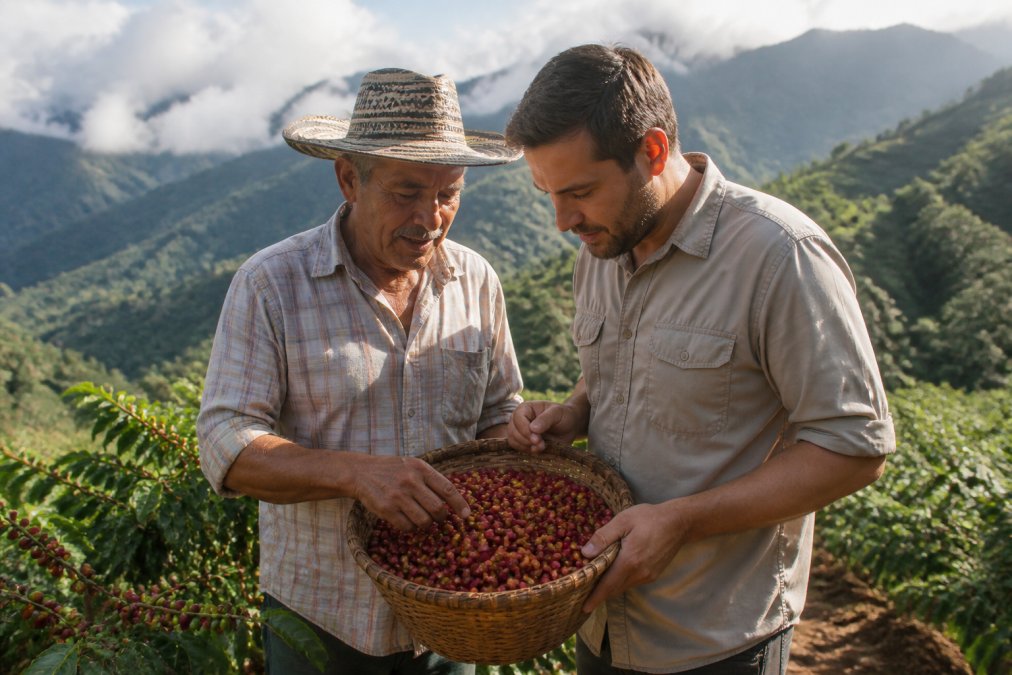
Start with the price mechanism. Most direct trade contracts use a two-part structure: a base price tied to the commodity market (often the C-price plus a differential) and a quality premium paid after cupping. The base protects the farmer against a bad market year; the premium rewards the extra labor that specialty-grade coffee requires, selective picking, controlled fermentation, raised-bed drying. A farmer who knows both numbers before harvest can plan, replant, and hire. One riding commodity volatility cannot.
Where the money goes next is where Colombian geography matters. In Huila, a common pattern is reinvestment in drying infrastructure, parabolic beds and mechanical dryers that reduce the risk of rain damage during the October-December mitaca harvest. In Nariño, where farms sit on steep slopes and average holdings are small, premiums more often fund labor during the main harvest and help cover the cost of replacing aging Caturra trees with Castillo, which carries higher rust resistance. In Cauca, indigenous and Afro-Colombian cooperatives have used above-market pricing to fund collective wet mills, which let members process cherry the same day it is picked instead of selling it as lower-value parchment.
The ripple effects extend past the individual farm. When a single producer earns more, spending tends to stay in the community, supporting local schools, services, and small businesses. Coffee grower cooperatives often negotiate these terms collectively, which gives smaller farms leverage they would not have alone. That collective structure is also what makes verification possible: a cooperative can publish farm-gate pricing across dozens of members, while a single smallholder usually cannot.
What most coverage misses is that price stability matters as much as price level. A roaster signing a three-year commitment at a modest premium can do more for a farm's long-term health than a one-off high payment, because the farmer can finally justify the cost of renovation, stumping old trees, which takes two to three years to pay back. That is the trade-off nobody advertises: the highest per-pound price is not always the most useful one.
How Direct Trade Improves Flavor and Freshness
Shortening the supply chain does more for cup quality than most sourcing language admits.
When a roaster buys directly, they can specify harvesting practices, processing methods, and lot separation. That control shows up in premium cup profiles: cleaner flavor clarity, more distinct origin character, and fewer defects from mixed lots. Specialty Coffee Association cupping standards define the protocols roasters use to grade these qualities.
Freshness compounds the effect. Beans that move quickly from farm to roaster to your door retain more of the aromatics that fade in storage. This is where roast-to-order models separate themselves. Tinto Coffee Roasters roasts in small batches and ships within 48 hours of roasting, which means the bag on your counter is fresh.
The difference between a stale bag and a fresh one is not subtle. It is the difference between coffee you tolerate and coffee you look forward to.
Colombian Terroir and Varietals: What Direct Trade Preserves
Colombia's growing regions produce some of the most recognizable flavor profiles in the world, and direct trade is what keeps them distinct.
Terroir here means altitude, soil, rainfall, and the specific varietals a farm cultivates. Colombian beans from high-altitude farms, often grown between 1,200 and 1,800 meters, develop the brightness and balanced structure the country is known for. Common varietals like Caturra, Castillo, and Bourbon each carry their own cup characteristics.
Direct trade protects that diversity. When roasters buy by lot instead of by blend, a single farm's Caturra can be cupped and sold on its own merits rather than folded into a generic regional blend. The result is single-origin coffee that actually tastes like where it came from.
The alternative is what the commodity system produces: consistency without character, coffee that is technically fine and memorable for nothing.
Logistics, Verification, and Environmental Impact
The parts of direct trade that never make the marketing copy are the ones that determine whether it works. This is where the draft can go deeper than the generic guides, because the mechanics are Colombian-specific.
The export chain, step by step. A direct trade lot leaving a Colombian farm typically moves through: (1) harvest and wet milling at the farm or a local beneficiary, (2) drying to a target moisture range (commonly 10-12%), (3) transport to a bodega in a regional hub such as Pitalito, Popayán, or Pasto, (4) dry milling and export preparation, hulling, density sorting, hand sorting, and bagging in 70 kg jute sacks with GrainPro liners, (5) export documentation including the ICA phytosanitary certificate and the Federación Nacional de Cafeteros export registration, and (6) ocean freight, usually out of the Port of Buenaventura on the Pacific or Cartagena and Santa Marta on the Caribbean. Add customs clearance on the U.S. side, and the realistic transit from farm gate to a U.S. roastery is often six to twelve weeks. Smaller roasters frequently consolidate shipments or work through import partners to hit container minimums, which adds cost but keeps volumes manageable.
Verification is the harder problem. Because direct trade is largely unregulated, buyers have to build their own proof. A credible roaster will typically publish farm-gate pricing, share farm visit records, and name the producers behind each lot. Fair Trade USA certification standards offer one formal framework, but many direct trade roasters operate outside it entirely. For consumers, the practical test is simple: can the roaster name the farm, the region, the varietal, and the harvest window, and can they show what was paid? If any of those four is missing, the term is doing marketing work rather than sourcing work.
Environmental impact beyond the social story. Direct relationships make it easier to support practices that matter in Colombia specifically. Shade-grown systems, often under Inga, guamo, or nogal trees, protect migratory bird habitat and slow cherry maturation, which can concentrate sugars. Water-conscious processing matters in regions where wet milling has historically discharged mucilage into streams; eco-pulpers and recirculation systems cut water use dramatically.
Frequently Asked Questions
What does direct trade coffee mean for the farmer?
Direct trade coffee means farmers negotiate prices directly with roasters instead of selling through intermediaries at commodity market rates. This typically results in higher, more stable pay that covers production costs and supports farm infrastructure, technical assistance, and community development. For Colombian growers, direct relationships also provide feedback on quality and harvesting practices, helping them earn premium cup profiles and build sustainable livelihoods.
How does direct trade differ from Fair Trade certification?
Fair Trade sets a minimum price and certification standards through a third-party body, while direct trade relies on the roaster-farmer relationship and often pays above Fair Trade rates. Direct trade emphasizes supply chain transparency, traceability, and quality control through cupping scores. Fair Trade focuses on cooperative structures and social impact; direct trade focuses on direct-to-farm relationships, price stability, and origin character. Many roasters use both models depending on the farm.
Does direct trade coffee taste better than commodity coffee?
Direct trade coffee often tastes better because farmers receive incentives to improve harvesting practices, processing, and quality control. With direct feedback and fair compensation, growers can invest in farm infrastructure and produce premium cup profiles with greater flavor clarity and origin character. Commodity coffee is blended for consistency and low cost, while direct trade Colombian coffee highlights single-origin nuances like bright acidity and smooth body.
How can I verify that a roaster actually pays farmers fairly?
Ask the roaster for proof of farm-gate pricing, importer relationships, or certification documents. Many transparent roasters publish origin reports, visit farms, or work with exporters who share audit trails. Look for named farms, harvest dates, and cupping scores on the bag. If a roaster cannot explain where the beans come from or what was paid, that is a red flag. Direct trade claims should come with traceability, not just a label.