

Table of Contents
- Why the Roast Date Matters Most When You Identify Fresh Coffee Beans
- Step 1: Check the Roast Date and Understand Degassing
- Step 2: Inspect Bean Appearance for Visual Clues
- Step 3: Perform the Bloom Test for Carbon Dioxide Release
- Step 4: Evaluate Aroma and Fragrant Notes
- How Long Do Coffee Beans Stay Fresh and Peak Flavor Window
- Signs of Stale Coffee Beans and When to Replace Them
- How to Store Coffee Beans Fresh for Maximum Shelf Life
- Frequently Asked Questions
Last Updated: September 21, 2026
Why the Roast Date Matters Most When You Identify Fresh Coffee Beans
The roast date is your single best indicator of freshness. Coffee beans begin losing flavor the moment they cool from the roaster, which is why the ability to identify fresh coffee beans starts with checking when they were roasted.
At Tinto Coffee Roasters, we roast to order within 48 hours of shipment. Within two to three weeks of roasting, you're drinking coffee at its best; after that, the beans decline.
The roast date shows how long the beans have been degassing and whether they've passed their peak flavor window, the one piece of information the roaster controls and can guarantee.
Check the bag for a printed roast date. If you don't see one, that's a red flag, a company hiding the roast date is likely selling old inventory.
The degassing window and why timing matters
Degassing is when carbon dioxide escapes from beans after roasting. This is essential, CO2 release is part of what makes coffee taste good.
Here's the timing:
- First 24 hours: Heavy degassing occurs. Beans are too gassy for most brewing methods.
- Days 2-3: CO2 continues escaping at a steady rate. This is when the bloom test works best.
- Days 4-14: Degassing slows down. Aromatic compounds stabilize. Flavor peaks around day 7-10.
- Day 15+: Degassing is nearly complete. Beans are stable but starting to lose brightness.
The sweet spot for most coffee is between 5 and 14 days after roasting. This is when the beans have released enough gas to brew cleanly, but haven't yet started losing their vibrant flavor notes.
A bean that's one day old isn't fresher than one that's seven days old, it's just different. One day old, it's still too gassy; seven days old, it's hitting its stride.
Many buyers assume newer is always better, but beans at peak degassing, roughly one week post-roast, perform better in most brewing methods than freshly roasted beans.
Step 1: Check the Roast Date and Understand Degassing
Start here. Before you look at the beans themselves, find the roast date. This single piece of information filters out half the stale coffee on the shelf.
What to look for:
- A printed date on the bag (month/day/year format)
- The date should be recent, ideally within the last 14 days
- No roast date printed? Move on. That coffee is old.
Calculate how many days have passed since roasting. If more than 30 days, the beans have likely lost peak aromatic compounds and are past their best window.
The roast date reveals the roaster's philosophy: companies that print it are confident in their product; those that hide it are selling old inventory.
When you order from Tinto Coffee Roasters, every bag includes a clear roast date so you know exactly how fresh your coffee is before it arrives.

Step 2: Inspect Bean Appearance for Visual Clues
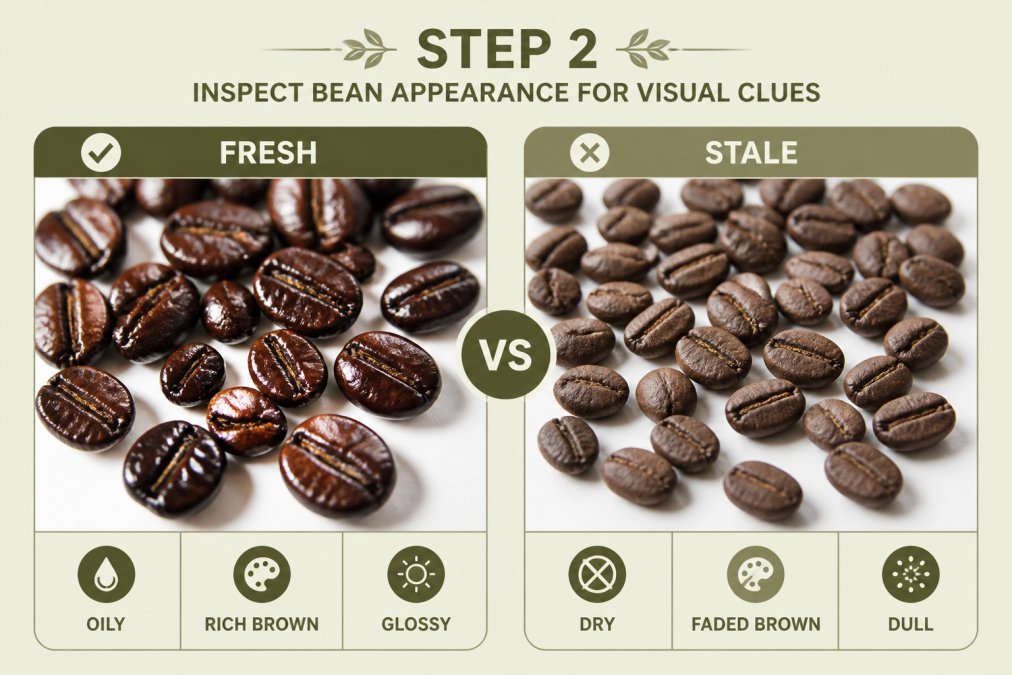
Once you've confirmed the roast date, look at the beans themselves. Visual inspection reveals a lot about freshness. Fresh beans have a distinct appearance that stale beans simply don't have.
Oily vs. dry surfaces and what they tell you
Fresh beans, especially dark roasts, often have a glossy shine from oil migration, oils moving toward the surface after roasting, a process that continues for several days.
An oily surface means the beans are young with natural oils still present, a sign of freshness for darker roasts.
Light roasts are typically drier because the roasting process is shorter. Don't judge them by dark roast standards; a dry surface on a light roast can still be fresh.
Stale beans look dull and matte as oxidation breaks down the oils. A two-month-old bean looks noticeably flatter than a fresh one.
Spotting visual defects and discoloration
Fresh beans should be uniform in color and whole. Small cracks are normal; deep splits or chips indicate damage during processing or storage.
Discoloration is a warning sign. Look for:
- Spots that are much darker than the rest of the bean
- Beans that look gray or ashy
- Visible mold or fuzzy growth (rare, but it happens)
- Beans that look bleached or faded compared to others in the bag
A few discolored beans are normal in an agricultural product, but if half the bag looks off, the coffee has been stored poorly or is very old.
Fresh beans from a quality roaster are visually consistent in size, color, and texture, a sign of careful sorting and controlled roasting.
Step 3: Perform the Bloom Test for Carbon Dioxide Release
The bloom test is one of the most reliable ways to check freshness. It's simple and works with any brewing method.
Here's how it works:
- Grind your beans to medium consistency (similar to sand)
- Pour hot water (around 195-205°F) over the grounds
- Watch for the bloom, a visible rise and bubbling of the coffee grounds
- Time it, a good bloom lasts 30-45 seconds and is vigorous
Fresh beans bloom dramatically, the grounds puff up, bubbles form and pop, and you may hear the carbon dioxide escaping.
Step 4: Evaluate Aroma and Fragrant Notes
Smell the beans before you brew them. Aroma is one of the fastest freshness indicators.
How Long Do Coffee Beans Stay Fresh and Peak Flavor Window
Coffee beans don't go bad on a specific date. They decline gradually. Understanding the timeline helps you plan purchases and know when to replace old beans.
The freshness timeline:
- Days 1-3: Beans are degassing heavily. Flavor is muted and gassy.
- Days 4-7: Degassing slows. Aromatic compounds stabilize. Flavor begins emerging.
- Days 7-14: Peak flavor window. This is when most coffee tastes best.
- Days 15-30: Flavor remains good, but brightness fades slightly. Still excellent coffee.
- Days 30-60: Noticeable decline in aroma and complexity. Still drinkable but not optimal.
- Day 60+: Significant flavor loss. Oxidation is advanced. Coffee tastes flat.
Signs of Stale Coffee Beans and When to Replace Them
Stale beans show clear signs. Learn to recognize them and you'll never brew disappointing coffee.
The most obvious signs:
- No roast date on the bag, If the roaster won't print it, the coffee is old
- Weak or absent bloom, Fresh beans bloom vigorously; stale beans barely respond
- Flat or musty aroma, Fresh beans smell complex and inviting; stale beans smell dull or cardboard-like
- Dull, matte surface, Fresh beans have shine; stale beans look flat
- Weak flavor in the cup, The coffee tastes thin and lacks complexity
- No acidity or brightness, Stale coffee tastes flat and one-dimensional
How to avoid buying stale beans:
- Buy from roasters who print the roast date
- Purchase smaller quantities more frequently
- Check the roast date before buying
- Ask the roaster how long the beans have been in inventory
How to Store Coffee Beans Fresh for Maximum Shelf Life
Storage determines how long beans stay fresh. The right approach extends the peak flavor window. The wrong approach accelerates staling.
The ideal storage setup:
- Airtight container, Oxygen is the enemy. Use a container with a tight seal. Mason jars work. Vacuum-sealed bags work better.
- Cool, dark location, Room temperature, away from direct sunlight. A kitchen cabinet is ideal. Avoid the counter where light hits it.
- Away from heat sources, Don't store beans above the stove or near an oven. Heat speeds oxidation.
- Stable temperature, Avoid the freezer unless storing for months. Temperature fluctuations cause condensation, which damages beans.
Storage timeline:
| Storage Method | Peak Freshness | Still Good | Past Optimal |
|---|---|---|---|
| Airtight container, room temperature | Days 7-14 | Days 15-30 | Day 30+ |
| Original bag (if sealed well) | Days 7-14 | Days 15-30 | Day 30+ |
| Open bag or loose storage | Days 3-7 | Days 8-14 | Day 14+ |
| Vacuum-sealed bag | Days 7-21 | Days 22-45 | Day 45+ |
Frequently Asked Questions
How do I know if my coffee beans are fresh?
Fresh coffee beans show a glossy shine, emit a strong fragrant aroma, and release visible CO2 bubbles when hot water is poured over them (the bloom test). Check the roast date on the bag, beans are at peak freshness within 2-4 weeks of roasting. If your beans smell flat or musty, they've begun to oxidize and lose flavor. Tinto Coffee Roasters roasts to order within 48 hours, so our beans arrive at peak freshness with the roast date clearly marked.
How long do coffee beans stay fresh after roasting?
Coffee beans remain at their best flavor for 2-4 weeks after roasting. During the first 24-48 hours, beans are still degassing (releasing carbon dioxide), so they're not yet optimal for brewing. After 4 weeks, oxidation begins to accelerate, and aromatic compounds fade, resulting in a flat, less vibrant cup. Whole beans stay fresher longer than ground coffee. Proper storage in an airtight container away from light and heat extends this window, but nothing replaces drinking beans soon after roasting.
What does the bloom test tell you about coffee freshness?
The bloom test measures how much carbon dioxide remains trapped in the beans. Fresh beans release vigorous bubbles and foam when hot water is first poured over them, a sign that aromatic compounds and CO2 are still present. Stale beans produce little to no bloom, indicating oxidation has progressed and flavor has degraded. A good bloom typically lasts 30-45 seconds and is a reliable indicator that your beans will deliver the full, complex flavor profile you're looking for in your cup.
Why does roast date matter more than the expiration date on coffee?
Roast date tells you exactly when the beans were roasted and lets you calculate their freshness window. Expiration dates are often vague and don't reflect how quickly coffee degrades after roasting. Coffee doesn't spoil like food, it slowly loses flavor through oxidation and CO2 loss. A bag roasted 10 days ago is fresher and more flavorful than one roasted 6 weeks ago, even if both are technically 'good.' Always choose beans with a recent roast date and brew them within 2-4 weeks for optimal extraction and flavor complexity.