

Table of Contents
- Essential Brewing Equipment
- Water Temperature Guidelines and Chemistry
- Best Grind Size for Colombian Coffee
- Water to Coffee Ratio for Smooth Brew
- Tinto Coffee Brewing Method: Step-by-Step
- Extraction Techniques and Bloom Process
- How to Brew Colombian Coffee in Different Methods
- Selecting Quality Colombian Beans and Altitude Considerations
- Frequently Asked Questions
Last Updated: September 19, 2026
Essential Brewing Equipment
To brew colombian coffee well, you need to start with the right tools. You don't need fancy gadgets, but a few essentials make a real difference.
A quality burr grinder is non-negotiable. Blade grinders create uneven particle sizes, which leads to inconsistent extraction. Burr grinders (either flat or conical) give you uniform grounds. A kitchen scale is equally important. Eyeballing your coffee-to-water ratio guarantees inconsistent results. A digital scale costs under $20 and transforms your brewing.
Beyond that, your brewing method determines what else you need. A gooseneck kettle helps with pour-over precision, but a regular kettle works fine if you're patient. A thermometer takes the guesswork out of water temperature. If you're using a French press, you'll want a timer. For drip machines, nothing extra is required.
The reality: most people own 80% of what they need already. A grinder and scale are your only real investments.
Water Temperature Guidelines and Chemistry
Water temperature controls extraction. Too cold, and your coffee tastes sour and weak. Too hot, and it tastes burnt and bitter.
The ideal range is 195-205°F. This is hot enough to extract flavors fully but cool enough to avoid scorching the grounds. If you're boiling water, let it cool for 30 seconds before brewing. That simple step brings it into the perfect zone.
Water chemistry matters more than most people realize. Tap water works, but filtered water is better. Chlorine and minerals in tap water interfere with flavor. If your tap water is hard (high mineral content), consider using filtered water. Distilled water is actually too pure, it can make coffee taste flat. Filtered tap water hits the sweet spot.
The bloom phase depends on water temperature. Hotter water blooms faster. At 200°F, expect 30 seconds of bloom time. This is when CO2 escapes from the grounds and water begins penetrating them.
Best Grind Size for Colombian Coffee
Grind size determines how fast water passes through the grounds. Wrong grind size means wrong extraction.
For drip coffee makers, use a medium grind. Think of it like sea salt, not powder, not chunks. Medium grind gives water enough time to extract flavor without pulling out bitterness.
For French press, go coarser. The longer steeping time (4 minutes) needs larger particles. A coarse grind prevents over-extraction and sediment in your cup.
Pour-over works with medium or medium-coarse grind, depending on your pour speed. Faster pouring needs coarser grounds. Slower, controlled pouring works with medium.
Cold brew needs the coarsest grind of all. Steep time is 12-24 hours, so you need large particles to slow extraction way down.
The mistake most people make: using the same grind for every method. Your grinder's settings should match your brewing technique. If you're switching between methods, adjust your grind size accordingly.
| Brewing Method | Grind Size | Particle Feel |
|---|---|---|
| Drip Coffee Maker | Medium | Like sea salt |
| French Press | Coarse | Like breadcrumbs |
| Pour-Over | Medium to Coarse | Between sea salt and breadcrumbs |
| Cold Brew | Very Coarse | Like peppercorns |
Water to Coffee Ratio for Smooth Brew
The coffee-to-water ratio is the foundation of consistency. Get this right, and every cup tastes balanced.
The standard ratio is 1:16 by weight. That means 1 gram of coffee to 16 grams of water. For a 6-ounce cup, use about 0.4 ounces of coffee (roughly 11 grams). Scale up from there.
If that ratio tastes weak to you, try 1:15. If it tastes too strong, try 1:17. Most people land somewhere between 1:15 and 1:17 depending on their taste preference.
Here's the practical version: use 1-2 tablespoons of ground coffee per 6 ounces of water. One tablespoon gives you a lighter cup. Two tablespoons gives you something fuller. Start with 1.5 tablespoons and adjust from there.
The beauty of the ratio system is repeatability. Once you find your sweet spot, you can make the same cup every morning. No guessing. No surprises.
At Tinto Coffee Roasters, we recommend starting with a 1:16 ratio and adjusting based on your taste. Our small-batch Colombian beans are roasted to bring out smooth, balanced flavors at this ratio.

Tinto Coffee Brewing Method: Step-by-Step
The traditional tinto brewing method is simple and forgiving. It's how coffee is made in Colombian homes and cafes every day.
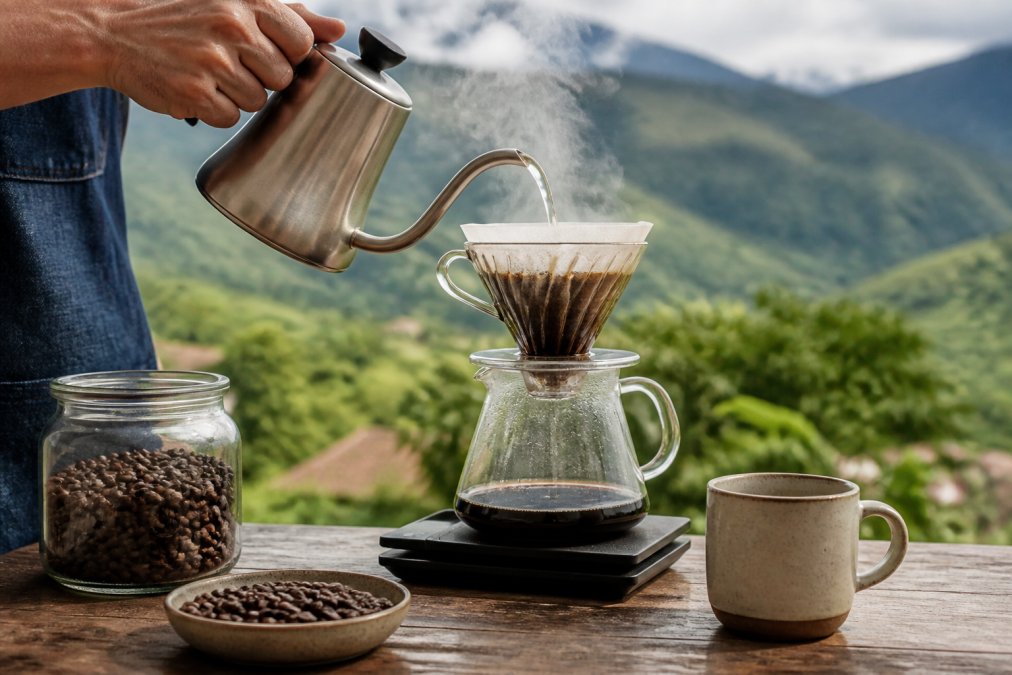
Step 1: Measure Your Coffee and Water Weigh out your beans and water using your kitchen scale. Use the 1:16 ratio. Grind your beans to medium size right before brewing.
Step 2: Heat Your Water Boil water and let it cool for 30 seconds. You want 195-205°F. If you don't have a thermometer, 30 seconds off boil is close enough.
Step 3: Bloom the Grounds Pour just enough hot water to saturate the grounds (about 1 ounce of water per 0.4 ounces of coffee). Wait 30 seconds. This releases CO2 and prepares the grounds for full extraction.
Step 4: Pour Slowly Pour the remaining water in a circular motion. Take your time. The total brew time should be 3-4 minutes. Slow, steady pouring extracts flavor evenly.
Step 5: Brew and Taste Let the coffee finish dripping. Pour into your cup and taste immediately. The coffee is at peak flavor for about 15 minutes after brewing.
This method works with pour-over cones, Melitta-style drippers, or even a simple cloth filter. The steps are the same.
Extraction Techniques and Bloom Process
Extraction is the process of pulling flavors from coffee grounds. Good extraction means balanced flavor. Bad extraction means sour or bitter coffee.
The bloom phase is where extraction begins. When hot water first hits dry grounds, CO2 gas escapes. This gas creates a barrier that prevents water from reaching the grounds. Blooming releases that gas and allows water to penetrate evenly.
A 30-second bloom is standard. During this time, don't pour more water. Let the grounds just sit in contact with the hot water. You'll see them swell slightly as they absorb moisture.
After the bloom, pour the rest of your water slowly. This is called the main pour. Pouring slowly keeps the water in contact with the grounds long enough for full extraction. Fast pouring means water rushes through without pulling out enough flavor.
The total brew time, from first water contact to last drop, should be 3-4 minutes for drip and pour-over methods. If it's faster, your grind is too coarse. If it's slower, your grind is too fine.
Under-extraction happens when water moves through grounds too fast. The coffee tastes sour and thin. Over-extraction happens when water stays too long. The coffee tastes bitter and harsh. The bloom and pour technique balances these two extremes.
How to Brew Colombian Coffee in Different Methods
Colombian coffee adapts well to different brewing techniques. Each method brings out slightly different flavors from the same beans.
Drip Coffee Maker
Drip machines are the easiest method for consistent results. Fill your machine's water reservoir. Add a paper or metal filter. Use medium-ground coffee at a 1:16 ratio.
Start the machine and let it run. Total brew time is usually 5-8 minutes depending on your machine. The coffee is ready when dripping stops.
Drip machines maintain water temperature well, so you get even extraction. The downside is less control over the process. But for busy mornings, drip machines are reliable.
Tinto Coffee Roasters' whole bean and ground options work perfectly in drip machines. Our medium roast is designed for everyday brewing methods like this.
French Press
French press brewing is immersion-based. The grounds sit in hot water for the full brew time, then you press down a metal filter to separate grounds from liquid.
Use coarse grounds.
Pour-Over
Pour-over gives you the most control. You decide water temperature, pour speed, and total brew time. This appeals to people who like to dial in their coffee.
Cold Brew and Iced Tinto
Cold brew is simple but requires patience. Use very coarse grounds. Combine grounds and cold filtered water at a 1:4 ratio (1 part coffee to 4 parts water). Stir to combine.
Selecting Quality Colombian Beans and Altitude Considerations
Not all Colombian coffee is the same. Where and how it's grown changes the flavor profile.
Frequently Asked Questions
What is the best grind size for Colombian coffee?
The best grind size for Colombian coffee depends on your brewing method. For drip machines and pour-overs, use a medium grind similar to sand. For French press, use a coarse grind to prevent sediment in your cup. For espresso, use a fine grind. Colombian beans at altitude develop balanced acidity and body, so uniformity in grind size matters, uneven particles extract at different rates, affecting your brew's flavor profile and mouthfeel.
What water-to-coffee ratio produces the smoothest cup?
A 1:16 ratio (one part coffee to 16 parts water) is the standard for smooth, balanced extraction. For example, use 1 ounce of coffee grounds to 16 ounces of water. This ratio works well for most brewing methods and Colombian beans, delivering the acidity and body without over-extraction. Adjust slightly based on your taste: use less water for stronger flavor, more for a lighter cup. Always use filtered water at 195-205°F for optimal results.
Do I need special equipment to brew Colombian coffee well?
No. A simple drip machine, French press, or pour-over works beautifully with Colombian beans. What matters most is water temperature (195-205°F), grind size consistency, and brew time. If you already own a regular drip coffee maker, freshly roasted Colombian beans will taste noticeably better than grocery-store options, no fancy equipment required. Single-serve pods like The Sophia offer convenience for busy mornings without sacrificing quality or flavor profile.
How does altitude affect Colombian coffee's roast profile and flavor?
Colombian beans grown at higher altitudes (1,200-1,800 meters) develop slower, creating denser beans with more complex sugars. This altitude allows roasters to build fuller body and balanced acidity without over-roasting. Higher-altitude beans typically show citrus undertones, caramel notes, and cleaner flavor profiles. Small-batch roasters adjust roast profiles specifically for altitude-grown beans to highlight these characteristics, resulting in smoother, more nuanced cups compared to lower-altitude coffees.