

Table of Contents
- Why Ethical Coffee Sourcing Claims Are Hard to Verify
- Start With Coffee Supply Chain Transparency
- Questions to Ask Coffee Companies About Sourcing
- What Ethical Coffee Certifications Prove, and What They Do Not
- How to Verify Claims Beyond Certification Logos
- Direct Trade Coffee: What the Label Does and Does Not Guarantee
- A Roaster Scorecard: Comparing Ethical Coffee Sourcing at a Glance
- Conclusion
- Frequently Asked Questions
Last Updated: October 14, 2026
Why Ethical Coffee Sourcing Claims Are Hard to Verify
Ethical coffee sourcing means buying coffee that pays farmers fairly, protects workers, and limits harm to the land.
Grocery aisles are full of "sustainable," "direct trade," and "responsibly sourced." Few of those words have a legal definition, so a roaster can print them without proving anything.
At Tinto Coffee Roasters, we buy small lots and roast to order, and we still get asked how we check this.

This guide covers what to request, what certifications prove, and how to compare roasters on facts instead of slogans.
Start With Coffee Supply Chain Transparency
Coffee supply chain transparency means a company can name the farms, cooperatives, or regions its beans came from, and say what it paid. Without it, there is nothing to verify.
Most roasters stop at the country. "Colombia" or "Ethiopia" tells you almost nothing, a country is not a farm, and a farm is not a wage.
What a Transparent Supply Chain Actually Discloses
A transparent supply chain discloses four things:
- The specific farm, cooperative, or washing station
- The region and altitude where the coffee grew
- The price paid to the producer, or how it was set
The fourth disappears first: a roaster may name a farm but go quiet when asked who checked the payment.
Where Traceability Breaks Down: Blends and Mixed Lots
Single-origin bags are easier to trace. Blends are murkier: beans from several countries, importers, and harvests get mixed, and the trail from cup back to farm is gone. That does not make the coffee unethical, it makes it unverifiable at the farm level.
If farm-level proof matters, buy single-origin and ask for the farm name. If you love a blend, ask which components are traceable. A roaster who answers plainly is worth your money.
Questions to Ask Coffee Companies About Sourcing
Ask four questions and you will learn more in one email than from any label. The answers, or the silence, tell you where a company stands.
- Which farm or cooperative grew this coffee? A name, not a country.
- What did you pay per pound at the farmgate? The farmgate price is what the producer receives before export and shipping costs.
- Who verified that payment? An importer, an auditor, or nobody.
- What happens if a farm worker has a complaint? A real answer here is rare and revealing.
You do not need a formal audit, a short email works. Companies that source well answer quickly and specifically; companies that do not send back a paragraph about their "commitment to quality."
What Ethical Coffee Certifications Prove, and What They Do Not
Ethical coffee certifications are third-party programs that set standards for farming, labor, and environmental practice, then inspect producers against them.
That distinction is where most shoppers stop checking. A certified cooperative can sell some coffee as certified and some as conventional; only the certified portion earns a premium. If a roaster blends certified and uncertified beans, the front-of-bag label can still appear even though only part of the contents qualifies.
Fair Trade, Rainforest Alliance, and Organic: A Quick Read
| Certification | Main Focus | What It Confirms | What It Misses |
|---|---|---|---|
| Fair Trade | Farmer pay and cooperatives | Minimum price and a social premium | Does not cover every lot a co-op sells |
| Rainforest Alliance | Farming and environment | Land, water, and biodiversity practices | Not a wage guarantee on its own |
| Organic | Growing method | No prohibited pesticides | Says nothing about labor or pay |
None of these labels tells you the farmgate price on the bag in your hand. That gap you have to close yourself.
How to Check a Certificate Instead of Trusting the Logo
A logo is a claim; a certificate is evidence. The difference is four details you can request in one email:
- Certificate holder. Ask whose name is on the certificate. It is often the cooperative, exporter, or importer, not the roaster. If the roaster is not the holder, ask how the certified coffee was kept separate from uncertified coffee as it moved through the supply chain.
- Scope. Certificates list the products and sites they cover. A certificate for green coffee at a mill does not automatically cover a roasted, blended, retail bag. Ask whether the scope reaches the product you are buying.
- Validity dates. Certificates expire and are suspended. Ask for the issue date and expiration date, and confirm the certificate was active during the harvest that produced your coffee.
Most roasters can produce the first two items. The third and fourth are where answers get vague, and vagueness is itself information.
What Certification Genuinely Does Well
It would be a mistake to dismiss certification entirely. It creates an auditable, comparable baseline enforceable through suspension, gives producers access to premium markets, and forces record-keeping many small operations would not maintain alone.
The problem is not that certification is meaningless, it answers a narrower question than shoppers assume. It tells you a standard was met somewhere in the chain, not what happened on the specific farm that grew your coffee or what it was paid.
The Label Is a Starting Point, Not a Verdict
Use certification as a filter, not a finish line. A certified coffee from a roaster who also publishes farmgate prices and audit summaries is stronger evidence than the same logo with no other disclosure. The label narrows the field; the documents behind it decide the purchase.
How to Verify Claims Beyond Certification Logos
Verification beyond a logo comes down to documents. Ask for the paper trail, then check that names and numbers line up.
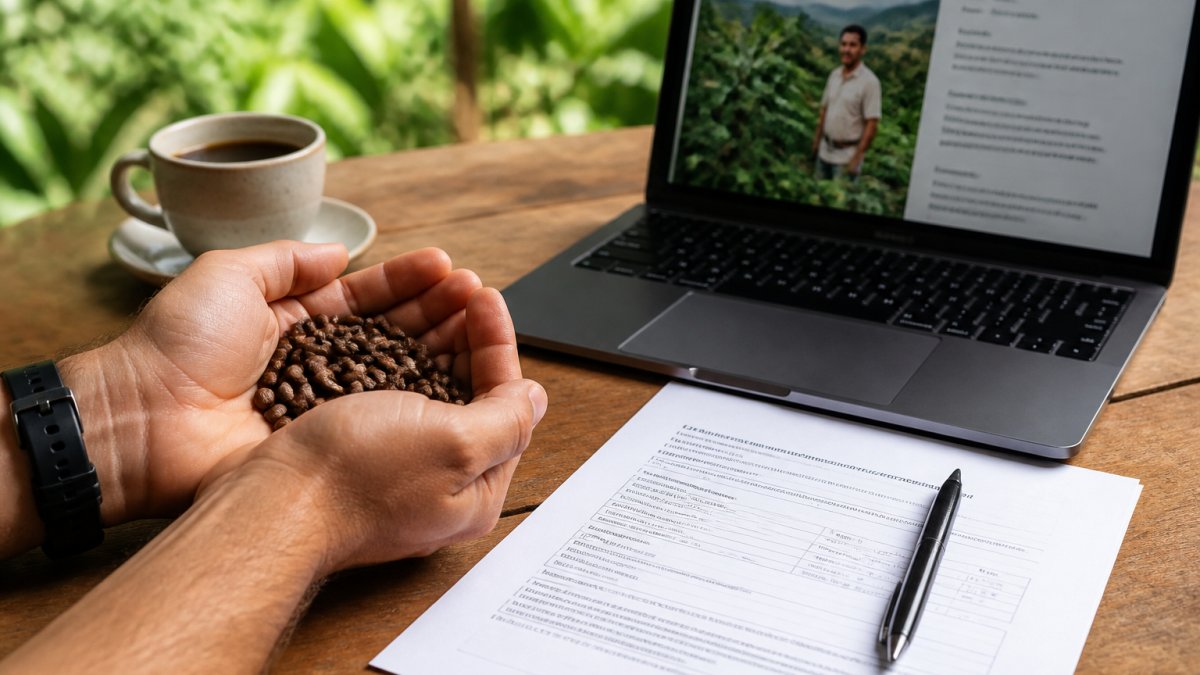
Here is a practical checklist. Request each item and note what you get back.
- Farm or cooperative name, with region
- Farmgate price paid, per pound
- Importer or exporter named
- Certification certificate with a valid date
Independent auditing and grievance mechanisms are the two items most roasters cannot produce.
Federal rules on labeling back this up. The FTC guidance on environmental marketing claims requires advertisers to hold evidence for the claims they make.
Direct Trade Coffee: What the Label Does and Does Not Guarantee
Direct trade coffee means a roaster buys straight from a producer or cooperative, cutting out some middlemen.
The label does not guarantee a higher price, require an audit, or set a minimum. It describes a relationship, and relationships vary widely.
Some direct trade programs pay well above market and publish their numbers.
This is where farm-level sourcing questions pay off.
A Roaster Scorecard: Comparing Ethical Coffee Sourcing at a Glance
A scorecard turns scattered answers into a comparable number. The version below weights evidence over claims, so a roaster who publishes documents scores higher than one who only publishes adjectives. Score each row 0 to 2, then total: 12 or higher out of 18 signals a roaster worth buying from.
| Criterion | Score 0 | Score 1 | Score 2 |
|---|---|---|---|
| Farm or co-op named | Country only | Region named | Specific farm or co-op named |
| Traceability level | Blend, origin unknown | Regional blend | Single lot or single farm |
| Farmgate price disclosed | No | Range or "above market" | Exact price per pound |
| Payment timing | Not addressed | General statement | Stated terms (e.g., on delivery) |
| Certification evidence | Logo only | Certificate named | Certificate with holder, scope, and dates |
| Independent audit | None | Self-reported | Third-party auditor named |
| Worker grievance channel | None | General contact form | Named, confidential worker channel |
| Public sourcing report | None | Occasional blog post | Annual report with numbers |
| Responsiveness to questions | No reply | Vague reply | Specific reply within a week |
How to Score Without Guessing
Score only what you can point to. A website, an email reply, and a certificate PDF are scoreable; a mission statement is not.
Two rows deserve extra weight: farmgate price and payment timing are the rows most roasters cannot fill, and the ones that most directly affect whether money reached the producer. A roaster who scores well everywhere except those two has a marketing program, not a sourcing program.
Reading the Total
- 0-6: Claims without evidence. Buy on taste alone, not on ethics.
- 7-11: Partial transparency. Some real disclosure, some gaps. Ask follow-up questions before trusting the ethical framing.
- 12-15: Strong. Documents exist, names are given, and at least one independent check is in place.
- 16-18: Exceptional. This is rare, and it usually means the roaster treats sourcing data as a public commitment rather than a marketing asset.
Traceability Has Levels, and Blends Cap the Score
A single-farm lot can reach the top of the traceability row; a regional blend cannot, no matter how good the roaster is. That is not a moral judgment, blending is a legitimate craft choice, but it limits how far a sourcing claim can be verified. If farm-level proof matters, single-origin is the only format that supports it. If you prefer a blend, ask which components are traceable and score it on its weakest component, not its best.
What the Scorecard Cannot Do
A scorecard measures disclosure, not outcomes. A roaster can honestly disclose a low farmgate price and still score well. It tells you whether the roaster is telling the truth, not whether the truth is good enough, use it to separate honest operators from vague ones, then judge the numbers by your own values.
At Tinto Coffee Roasters, we source small lots of Colombian arabica, roast to order within 48 hours, and grade each batch for quality and flavor consistency. Our Tinto Coffee Bag is filled to order in ground or whole bean, sealed from roast day to brew day, at $24.99. If you want the convenience of single-serve, "The Sophia" Colombian Pods use the same single-origin Colombian beans, oxygen-sealed for freshness, also $24.99.

Conclusion
Verifying ethical coffee sourcing takes a few emails and a skeptical eye, and most shoppers never do it, which is exactly why it works. Ask for the farm name, the farmgate price, and who checked it.
At Tinto Coffee Roasters, we keep it simple. Start with our Tinto Coffee Bag or the "The Sophia" Colombian Pods, and taste what careful sourcing actually delivers.
Frequently Asked Questions
How can you tell if coffee is ethically sourced?
Start by checking whether the roaster publishes farm names, regions, and the price paid at the farmgate. Ethical coffee sourcing usually comes with specific details: which cooperative grew the beans, how long the relationship has lasted, and what premiums were paid above commodity rates. Certifications like Fair Trade or Rainforest Alliance add third-party verification, but they are not the whole picture. A roaster that answers sourcing questions directly and shares documentation is a stronger signal than a logo alone.
Are coffee sourcing certifications enough to prove ethical practices?
No. Ethical coffee certifications set minimum standards and require third-party audits, but they do not guarantee living income for every farmer or full supply-chain transparency. A certified bag can still contain beans from mixed lots where individual farm payments are not traceable. Treat certification as one data point. Ask for farm-level payment details, audit summaries, and grievance mechanisms to get a fuller picture of how a roaster actually operates.
Is direct trade coffee always ethical?
Not automatically. Direct trade coffee means a roaster buys from farmers or cooperatives without intermediaries, which can lead to better prices and stronger producer relationships. However, the term is not legally defined or independently audited. A roaster could claim direct trade while paying below living income or skipping safe working conditions. Ask what price was paid, how it compares to the commodity market, and whether the relationship includes long-term contracts or pre-harvest financing.
What is the least toxic coffee brand?
Organic certification limits synthetic pesticides and fertilizers, which reduces chemical residue risk. Look for roasters that roast in small batches with clear quality grading. Tinto Coffee Roasters, for example, grades its Colombian arabica for quality and flavor consistency and roasts to order within 48 hours.