

Table of Contents
- What the Coffee Peak Flavor Window Actually Means
- How Long to Rest Coffee After Roasting (By Roast Level)
- How Long Do Coffee Beans Stay Fresh?
- How to Find Your Coffee's Peak at Home
- Signs Coffee Beans Are Stale (and What Changed)
- How to Store Coffee Beans to Protect the Peak Window
- How Brewing Method Changes the Perceived Peak
- Conclusion
- Frequently Asked Questions
Last Updated: October 6, 2026
What the Coffee Peak Flavor Window Actually Means
The coffee peak flavor window is the stretch of days after roasting when a bean's aromatics, sweetness, and complexity show up at their best in the cup. It starts after the beans finish resting and ends before age flattens them.
That range is wide on purpose. There is no single number, and any guide that hands you one is guessing.
Peak Flavor vs. Peak Freshness: Why They Differ
Peak freshness is about chemistry settling down. Peak flavor is about what you actually taste.
Freshly roasted beans release carbon dioxide for days. During that time they brew unevenly and taste sharp. Once the gas slows, water extracts the grounds more evenly, and the sweetness and aroma come forward.
So the freshest coffee is not always the best-tasting coffee. At Tinto Coffee Roasters, we roast to order and ship within 48 hours, but we still tell people to give the bag a few days before the first brew.

How Long to Rest Coffee After Roasting (By Roast Level)
Resting coffee after roasting means letting the beans sit, whole and sealed, so trapped gas can escape before you brew. Skip it, and your first cups taste thin or harsh. The right resting period depends mostly on how dark the roast is, but density, processing, and roast development all shift the timeline too.
Why Resting Times Vary: The Variables Behind the Numbers
Most guides hand you a day range and move on. The ranges conflict because they ignore the variables that actually drive degassing:
- Bean density. High-grown, hard-bean coffees (think Kenyan or Ethiopian lots grown at altitude) are denser and hold carbon dioxide longer. They often need the long end of any range.
- Roast development. Lighter roasts preserve more of the bean's cellular structure, so CO2 escapes slowly. Darker roasts crack the structure open, and gas leaves fast.
- Roast date vs. ship date. A bag that sat in a warehouse for a week is already partway through its rest before you open it. Always check the roast date, not the purchase date.
Resting Times for Light, Medium, and Dark Roasts
A common approach is to rest longer for lighter roasts and shorter for darker ones:
- Ultra-light and light roasts: 7 to 14 days. Dense beans hold gas longer.
- Medium roasts: 4 to 7 days. The middle ground most drinkers land on.
- Dark roasts: 2 to 5 days. The roast process opens the bean structure, so gas leaves faster.
Processing matters too. Washed coffees tend to settle on the quicker end. Natural and honey-processed beans often need a few extra days before they taste balanced.
A Practical Resting Timeline by Roast and Process
Use this as a starting point, then adjust with your own tasting notes:
| Roast Level | Washed | Natural / Honey |
|---|---|---|
| Light | 10-14 days | 12-16 days |
| Medium | 5-8 days | 7-10 days |
| Dark | 2-4 days | 3-5 days |
These are starting windows, not rules. A dense light roast from a high-altitude farm may still taste sharp on day 14, while a softer medium roast can peak by day 5. The only way to know is to taste on a schedule (see the home tasting method below).
Specialty Coffee Association guidance on roast and freshness notes that roast development shapes how a coffee ages, which is why one universal resting number does not exist.
How Long Do Coffee Beans Stay Fresh?
Whole roasted coffee beans stay at their best for about 2 to 4 weeks after the roast date, then begin a slow decline. They do not spoil like milk. They just lose the volatile compounds that carry aroma.
Grinding speeds that up dramatically. Ground coffee can lose noticeable aroma within days, because far more surface area is exposed to oxygen.
Here is the practical version:
- Days 1-3: Resting. Brews may taste gassy or sharp.
- Days 4-14: The core flavor window for most roasts.
- Days 15-28: Still good, but aroma fades and brightness drops.
How to Find Your Coffee's Peak at Home
You can find your coffee's peak without any lab gear. Brew the same coffee the same way on a schedule, taste it plain, and write down what you notice. The day it tastes sweetest and most complete is your peak.
A Simple Tasting Method: Cup on Days 3, 7, 14, and 21
Pick one bag, one brewing method, and one recipe. Then:
- Day 3: Brew a small cup. Note aroma, sweetness, and any harsh edge.
- Day 7: Repeat. Most coffees start rounding out here.
- Day 14: Repeat. This is often the high point for light and medium roasts.
- Day 21: Repeat. If it tastes flatter than day 14, you found the decline.
Keep the water temperature, dose, and grind identical each time. Change one thing and you are tasting the change, not the coffee.
Taste the coffee black and at a warm, not hot, temperature. Sweetness and fruit notes show up as the cup cools. Scalding coffee hides them.
Signs Coffee Beans Are Stale (and What Changed)
Stale coffee announces itself in the cup, not on the bag. The most reliable signs are a dull, papery smell, a flat taste with no sweetness, and a finish that turns bitter or cardboard-like.
Watch for these:
- No aroma when you open the bag. Fresh beans hit you at the seam.
- Oily, tacky surface on a light roast. That usually means age, not roast level.
- Thin body. Watery texture with no coating on the tongue.
One honest caveat: some of what people call "stale" is really roast development. A very dark roast tastes smoky and bitter on day one. That is the roast, not the age.
How to Store Coffee Beans to Protect the Peak Window
Store coffee beans in an airtight container, away from light, heat, and moisture, at room temperature. Keep the bag sealed between brews and buy only what you will drink in a few weeks. Oxygen is the main enemy, and every time you open the bag, you feed it.
What Actually Degrades Coffee: The Four Enemies
Staleness is not one process. It is four working at once:
- Oxygen. Oxidizes the oils and aromatics that carry flavor. This is the fastest and most damaging factor.
- Heat. Accelerates every chemical reaction, including oxidation. A bag on top of the fridge ages faster than one in a cool cupboard.
- Light. UV rays break down volatile compounds. Clear glass jars on a sunny counter are a common mistake.
A one-way valve bag addresses oxygen and light but not heat or repeated opening. That is why the container matters as much as the bag.
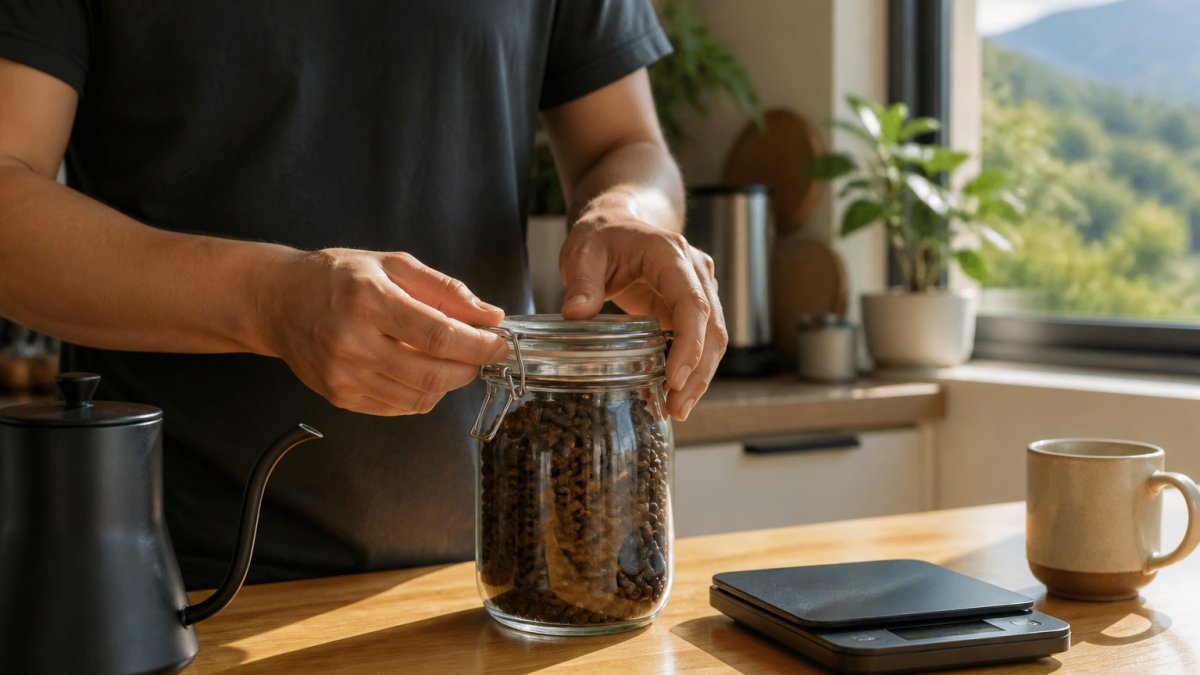
Storage Methods Ranked by Effectiveness
Not all storage is equal. Here is how the common options compare:
- Original one-way valve bag, sealed and stored cool. Good for short-term (1-2 weeks). The valve releases CO2 without letting oxygen in.
- Airtight opaque container. Better for daily use. Blocks light and limits oxygen exposure between brews.
- Vacuum-sealed container. Best for medium-term storage (2-4 weeks). Removes most of the oxygen headspace.
- Freezer, portioned and sealed. Best for long-term (1-3 months). Works well if done right, see below.
The Freezer: When It Helps and When It Hurts
Most advice says "skip the freezer." That is only half true. The freezer is one of the best tools for extending the peak window if you use it correctly:
- Portion first. Divide beans into single-week portions so you only thaw what you will use.
- Seal tightly. Use a vacuum bag or a freezer-safe airtight container. Oxygen is still the enemy in the freezer.
- Do not thaw and refreeze. Each thaw cycle introduces condensation, which is moisture damage.
A few habits that protect the window:
- Skip the fridge. Condensation forms every time the bag comes out.
- Skip the freezer for daily coffee. It works for long storage, not for a bag you open twice a day.
- Keep the original bag if it has a one-way valve. That valve lets gas out without letting air in.
Whole Bean vs. Ground: The Freshness Gap
Whole bean coffee holds its peak far longer than ground coffee. Grinding exposes the oils and aromatics to air all at once, so the clock speeds up.
If you brew daily, grind right before you brew. Our Tinto Coffee Bag comes ground or whole bean and is filled to order, so the roast date on the bag is close to the day it shipped.
How Brewing Method Changes the Perceived Peak
The same beans can taste peaked on one brewer and flat on another. Brewing method changes how much of the coffee you actually extract, and that shifts where the peak seems to land.
- Pour over: Shows aroma and clarity best. Rewards coffee at its peak, punishes it when flat.
- French press: Full body and oils. It masks age better than most methods.
- Espresso: Concentrated and unforgiving. Resting matters more here than anywhere.
If you brew espresso, add two or three days to your resting time. The pressure amplifies whatever the bean is doing.
For anyone who wants the routine to stay simple, our "The Sophia" Colombian Pods are oxygen-sealed for freshness and built for single-serve machines, ready in under a minute. For travel or the office, the Tinto Tube holds 54g of ground coffee in an airtight tube, enough for about 4 to 5 cups.


Do not judge a coffee on day one. Brewing a bag the day it arrives is the most common mistake we see, and it makes people write off a perfectly good roast. Give it a few days.
Conclusion
The hard part is not learning the numbers. It is buying coffee fresh enough that the window still matters when the bag reaches your kitchen.
That is the whole reason we roast to order and ship within 48 hours. Our beans are small-batch, graded for quality and flavor consistency, and sealed from roast day to brew day, so the peak window starts when you open the bag, not weeks before.
Frequently Asked Questions
How long after roasting does coffee reach its peak flavor?
Most coffee lands in its peak flavor window between 4 and 14 days after the roast date, but the exact timing depends on roast level. Light roasts often need 7 to 14 days of resting to open up, while dark roasts can taste best as early as 3 to 7 days. Beans stay enjoyable for several weeks after that, though the sweetness and complexity gradually flatten. Check the roast date on the bag and taste a cup every few days to find your own peak.
Should you let coffee rest after roasting?
Yes. Freshly roasted beans release carbon dioxide, a process called degassing, and brewing too soon can leave you with a flat, foamy, uneven cup. Resting lets that gas escape so water can extract flavor compounds properly. As a starting point, rest light roasts 7 to 14 days, medium roasts 4 to 10 days, and dark roasts 3 to 7 days. If your coffee tastes sharp or gassy, give it a few more days and try again.
Does whole bean coffee stay fresh longer than ground coffee?
Whole bean coffee holds its peak flavor far longer than ground coffee because the bean's surface area is much smaller. Once you grind, oxygen exposure speeds up quickly, and ground coffee can lose noticeable aroma within days rather than weeks. If you buy whole bean and grind right before brewing, you protect the peak window. For convenience, Tinto Coffee Roasters offers both whole bean and ground options, so you can pick what fits your routine.
How should you store coffee beans to preserve flavor?
Keep beans in an airtight container away from light, heat, and moisture. A cool, dark cabinet works better than a countertop next to the stove or a sunny windowsill. Skip the freezer for daily-use beans because repeated thawing introduces moisture, though you can freeze a sealed bag you will not open for weeks. Buy only what you will drink in two to four weeks, and check the roast date before you buy.