

Table of Contents
- Understanding Grind Size Basics for Colombian Coffee
- How Grind Size Affects Extraction and Flavor
- Grind Size for Your Brew Method
- Burr Grinder vs Blade Grinder for Specialty Coffee
- How to Adjust Coffee Grind Size for Better Results
- Coffee Grind Size Chart for Beginners
- Troubleshooting Common Brewing Issues
- Frequently Asked Questions
Last Updated: September 28, 2026
Understanding Grind Size Basics for Colombian Coffee
The best grind size for Colombian coffee beans depends entirely on your brewing method. Colombian beans, grown at altitude and known for their balanced acidity and smooth body, require precise particle size to extract their full flavor potential. Get the grind wrong, and you'll either pull out too much (over-extraction, bitterness) or too little (under-extraction, sourness). Get it right, and you unlock the clean brightness and chocolate notes that make Colombian coffee worth drinking.
Grind size controls extraction: water flows through grounds, dissolving soluble compounds that create flavor. Finer grinds expose more surface area, speeding extraction; coarser grinds slow it down. For Colombian beans, uniformity matters most, uneven particles extract at different rates, leaving some over-extracted and some under-extracted in the same cup.
This guide covers how to dial in your grind for Colombian coffee across drip machines, French press, espresso, and pour-over methods, plus troubleshooting tips.
How Grind Size Affects Extraction and Flavor
Extraction is the core concept: hot water dissolves soluble compounds that create flavor. Too little contact time yields sour, thin coffee; too much yields bitter, over-extracted coffee.
Coarse grinds have larger particles and less surface area, allowing water to flow quickly, ideal for French press steeping. Fine grinds have smaller particles and more surface area, slowing water flow, ideal for espresso's 25-30 second brew.
Under-extracted coffee tastes sour and thin; over-extracted tastes bitter and flat. Proper extraction brings out Colombian coffee's chocolate, nuts, caramel, and balanced acidity.
For Colombian beans, uniformity matters more than perfect size. A burr grinder produces uniform particles; a blade grinder creates dust and chunks, guaranteeing uneven extraction.
Grind Size for Your Brew Method
Different brewing methods require different grind sizes because they expose grounds to water in different ways and for different durations. Match your grind to your method, and extraction becomes predictable.
Standard Grind for Drip Coffee Makers
Drip coffee makers are the most common brewing method in homes and offices. Water drips through grounds for 4-6 minutes, giving you moderate contact time. You need a grind fine enough for proper extraction but coarse enough that water doesn't flow too slowly or get trapped.
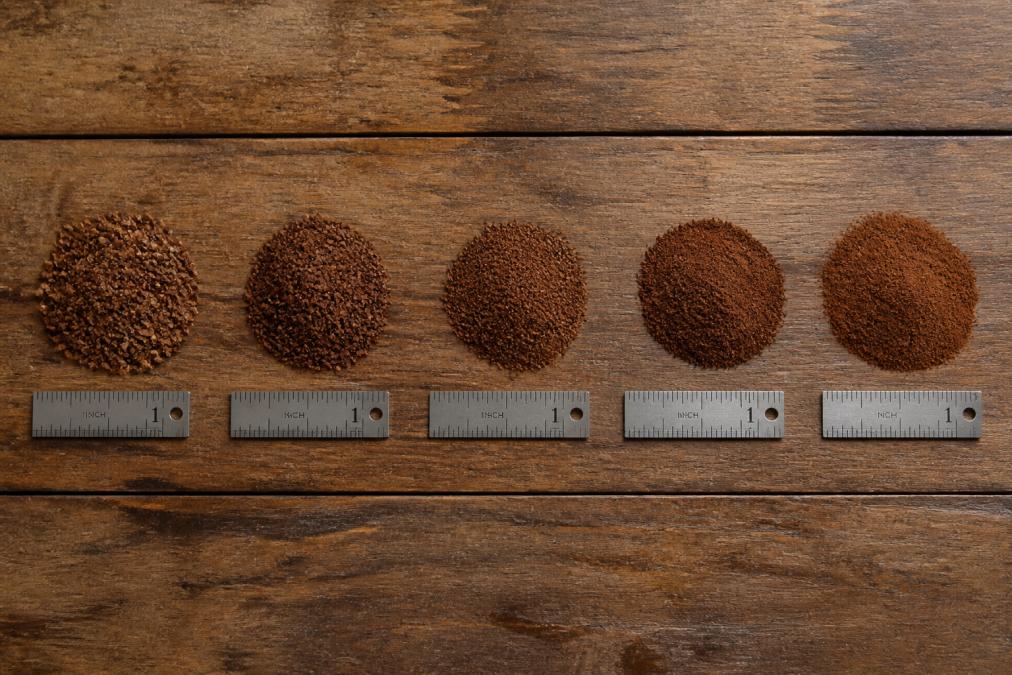
Use a standard (medium) grind for drip machines, like sand or fine sugar, slightly grainy between your fingers. This is the default for most pre-ground Colombian coffee because it works reliably across machines.
Brew at 195-205°F with 1-2 tablespoons per 6 ounces of water. Sour taste means grind is too coarse; bitter means too fine.
Coarse Grind for French Press and Cold Brew
French press and cold brew both use immersion brewing, grounds steep in water for extended periods. French press steeps for 4 minutes at hot temperature. Cold brew steeps for 12-24 hours at room temperature. Both methods need a coarse grind to prevent over-extraction during that long contact time.
A coarse grind for French press looks like breadcrumbs or sea salt. The larger particles slow water's movement, preventing bitterness during a 4-minute steep.
Cold brew uses the same coarse grind with cold water, which extracts more slowly. A 1:4 ratio over 12-24 hours yields smooth, sweet flavors. Concentrate keeps two weeks refrigerated.
Fine Grind for Espresso Machines
Espresso requires water forced through grounds under pressure for 25-30 seconds. Use a fine grind, nearly powder-like but not flour, to provide enough resistance and surface area for extraction.
Espresso grind is where precision matters most. Too coarse, and water rushes through in 10 seconds, under-extracting and tasting sour. Too fine, and water can't flow through at all, or flows so slowly that you over-extract and get bitterness. The difference between a great shot and a terrible one is often just a few notches on your grinder's dial.
Dialing in espresso means adjusting grind size while pulling shots until you hit the target: 18-20 grams of ground coffee in, 36-40 grams of liquid out, in 25-30 seconds. Start with a medium-fine grind and adjust from there. If your shot pulls too fast (under-extracted, sour), go finer. If it pulls too slow (over-extracted, bitter), go coarser. This process is called dialing in, and it's the foundation of espresso technique.
Medium-Coarse Grind for Pour-Over Methods
Pour-over methods, including Chemex, V60, and Kalita Wave, sit between drip and French press in terms of contact time. Water flows through grounds in 3-4 minutes, with a bloom phase at the start where grounds are saturated but not yet dripping.
Use a medium-coarse grind for pour-over, slightly coarser than standard drip but finer than French press. The bloom phase (30 seconds of saturation before pouring) allows CO2 to escape from the grounds, which improves extraction. Then pour slowly in circles to maintain consistent water contact.
Pour-over gives you more control than drip machines because you control the pour rate manually. This makes it ideal for dialing in Colombian beans: if your first pour tastes slightly sour, adjust your next pour to be slower, allowing more contact time. If it tastes bitter, pour faster.
Burr Grinder vs Blade Grinder for Specialty Coffee
A burr grinder is non-negotiable for specialty coffee. A blade grinder is not.
A burr grinder uses two rotating surfaces (flat or conical burrs) with a small gap between them. Beans fall into that gap and are crushed to a consistent size. You adjust the gap to change grind size. The result is uniform particles, every piece is roughly the same size.
A blade grinder is a blender with a spinning blade. It chops randomly. You get a mix of dust, powder, sand-sized pieces, and chunks. That inconsistency guarantees uneven extraction: dust over-extracts, chunks under-extract, and your cup is muddled.
For Colombian coffee, uniformity matters because these beans deserve proper extraction. Uneven grind sizes waste the careful sourcing and roasting that goes into premium beans. A burr grinder costs $20-50 for a basic manual model and $80-150 for an electric one. That's a one-time investment that improves every cup you make for years.
Conical burrs are slightly more forgiving and produce less heat (important if you grind frequently). Flat burrs are slightly faster and more precise. Either works well. What matters is that you're getting consistent particle size, not random chunks and dust.
How to Adjust Coffee Grind Size for Better Results
Dialing in your grind is simple once you understand the relationship between grind size and extraction. Start with a baseline grind for your brew method, brew a cup, and taste it. Then adjust based on what you taste.
If your coffee tastes sour or thin: Your grind is too coarse. Water is flowing through too fast, under-extracting. Make your grind finer and brew again. Move your grinder setting one notch finer at a time, small adjustments make big differences.
If your coffee tastes bitter or dry: Your grind is too fine. Water is moving too slowly, over-extracting. Make your grind coarser and brew again.
If your coffee tastes flat or muddy: Your grind is inconsistent, or your beans have been sitting open (losing freshness). Check that your grinder is producing uniform particles. If you're using pre-ground coffee, switch to whole bean and grind fresh. Tinto Coffee Roasters roasts to order and ships sealed, so you're getting maximum freshness and aroma from grind day to brew day.
If your coffee tastes right but weak: You're extracting correctly but not using enough coffee. Increase your coffee-to-water ratio. For drip, go from 1 tablespoon per 6 ounces to 1.5 or 2 tablespoons.
Keep a simple log: grind setting, brew time, water temperature, and what the coffee tastes like.
Coffee Grind Size Chart for Beginners
| Brew Method | Grind Size | Particle Feel | Brew Time | Water Temp |
|---|---|---|---|---|
| French Press | Coarse | Breadcrumbs | 4 min | 195-205°F |
| Cold Brew | Coarse | Breadcrumbs | 12-24 hrs | Room temp |
| Drip Machine | Standard (Medium) | Fine sand | 4-6 min | 195-205°F |
| Pour-Over | Medium-Coarse | Coarse sand | 3-4 min | 195-205°F |
| Espresso | Fine | Nearly powder | 25-30 sec | 195-205°F |
| AeroPress | Medium-Fine | Slightly finer sand | 1-2 min | 195-205°F |
Troubleshooting Common Brewing Issues
When your Colombian coffee doesn't taste right, grind size is often the culprit, but not always. Here's how to diagnose and fix the most common problems.
Frequently Asked Questions
Does grind size change the flavor of Colombian coffee?
Yes, grind size directly affects how water extracts flavor from Colombian beans. A finer grind increases surface area, pulling out more oils and compounds, which can highlight the bean's bright acidity and fruity notes. A coarser grind reduces extraction, creating a smoother, less acidic cup. Colombian beans grown at altitude tend to have balanced acidity and sweetness, so matching your grind size to your brew method ensures you taste the full, intended flavor profile without bitterness or sourness.
What is the best grind size for a pour-over coffee maker?
Pour-over brewing works best with a medium-coarse grind, similar to sea salt texture. This size allows water to flow through the grounds in 3-4 minutes, extracting balanced flavor without over-extraction. Colombian beans at this grind size produce clean, bright cups with good body. Start with a 30-second bloom (wetting the grounds before brewing) to release CO2, then pour slowly. If your coffee tastes sour, try a slightly finer grind; if it tastes bitter, go coarser.
Should I use a burr or blade grinder for my coffee?
A burr grinder is essential for specialty coffee, including Colombian beans. Burr grinders produce uniform particle size, which ensures even extraction and consistent flavor cup to cup. Blade grinders chop beans randomly, creating dust, fines, and large chunks that extract unevenly, leading to bitter or sour coffee. For Colombian coffee where you want to highlight the bean's balanced acidity and smooth body, a burr grinder gives you the control and consistency needed to dial in the perfect grind size for your brew method.
How do I adjust my grind size if my coffee tastes bitter?
Bitterness signals over-extraction, meaning water has pulled too many compounds from the grounds. Adjust by grinding coarser (larger particles), which reduces surface area and slows water flow. Start with a small adjustment, move your grinder setting up one or two notches, and brew again. Also check your water temperature (aim for 195-205°F) and brew time. If using a drip machine, coarser grounds should take 4-5 minutes. Colombian beans are naturally balanced, so a coarser grind often reveals their smooth, sweet character without the harsh bite.