

Table of Contents
- Why Verifying Ethical Coffee Farming Matters More Than Ever
- Fair Trade vs Direct Trade Coffee: What's the Real Difference?
- Coffee Certification Labels Explained: What Each One Actually Guarantees
- How to Read a Coffee Bag Label Like a Detective
- The Economic Breakdown of a Cup: Where Your Money Actually Goes
- How to Support Ethical Coffee Roasters Without Getting Fooled
- Tools and Databases for Verifying Supply Chain Claims
- Frequently Asked Questions
Last Updated: September 11, 2026
Why Verifying Ethical Coffee Farming Matters More Than Ever
Verifying ethical coffee farming means tracing a bag of beans back to the farm, the cooperative, and the price paid to the grower, not just trusting a logo on the front of the package. This guide from Tinto Coffee Roasters walks through the labels, the economics, and the questions that separate real transparency from marketing.
Coffee is one of the most heavily intermediated agricultural products on earth. Beans typically pass through exporters, importers, and roasters before reaching a shelf, and each handoff obscures the farm-gate price. That distance is exactly where greenwashing thrives. A roaster can print "sustainably sourced" on a bag without ever disclosing what it paid a farmer.
Below, we'll show you how to verify ethical coffee farming yourself: which certifications carry weight, which labels are decoration, and how to read a bag like someone who has actually stood in a wet mill in Huila. The stakes are simple. Either transparency is real and checkable, or it's a story.
Fair Trade vs Direct Trade Coffee: What's the Real Difference?
Fair Trade is a third-party certification system with audited standards and a guaranteed minimum price floor. Direct Trade is an unregulated term roasters use to describe buying straight from farms, with no universal definition or enforcement.
That distinction matters because one is verifiable and the other is a claim. Fair Trade certification requires cooperatives to meet labor, environmental, and democratic-organization criteria, and it sets a price floor designed to protect growers when commodity markets crash. You can check whether a roaster's importer is actually certified through Fair Trade USA's certification database.
Direct trade, by contrast, lives or dies on the roaster's own disclosures. A serious direct-trade roaster publishes farm names, altitudes, varietals, and often the price paid per pound. A weak one uses the phrase as a vibe. The term itself guarantees nothing.
So the honest answer to "which is better" is: it depends on the roaster, not the label. A certified Fair Trade cooperative with a long-term buyer relationship can outperform a flashy "direct trade" brand that visits once for photos. Ask for the receipts either way.
Coffee Certification Labels Explained: What Each One Actually Guarantees
Certification labels vary enormously in what they actually enforce. Some audit labor conditions and pay. Others only address farming methods. A few mean almost nothing at all.
Third-Party Certifications Worth Trusting
- Fair Trade Certified: Audits labor rights, bans forced and child labor, sets a minimum price floor and a social premium paid to the cooperative.
- USDA Organic: Verifies no prohibited synthetic pesticides or fertilizers. It says nothing about farmer pay or labor conditions, which is a common point of confusion.
- Rainforest Alliance: Combines environmental standards with some social criteria, including worker protections and wildlife habitat requirements.
- Bird-Friendly (Smithsonian Migratory Bird Center): The most rigorous shade-grown standard, requiring canopy cover that supports migratory bird habitat.
Labels That Sound Good but Mean Little
"Ethically sourced," "sustainably grown," "farm-direct," and "hand-picked" are unregulated marketing language. No third party verifies them. A roaster can print any of these tomorrow with zero proof.
How to Read a Coffee Bag Label Like a Detective
A label that supports verification typically includes four things: the country and region of origin, the farm or cooperative name, the altitude, and the roast date. Missing any of these is a signal, not necessarily a dealbreaker, but a signal.
Start with origin specificity. "Colombia" is a country. "Huila, Colombia" is a region. "Finca La Esperanza, Huila, Colombia" is a farm you can look up. The more specific the label, the more the roaster is staking its reputation on a checkable claim. Origin-specific labeling is one of the clearest markers of genuine traceability.
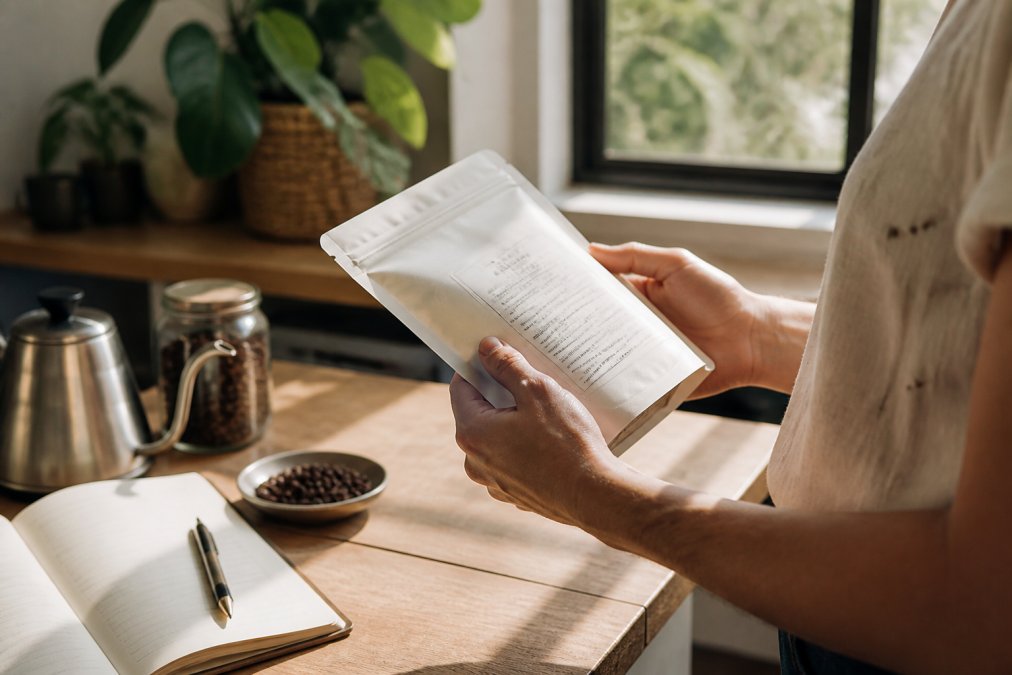
Then check the roast date, not just a "best by" date. Roast dates tell you how fresh the coffee is, and a roaster confident enough to print one is usually confident enough to disclose its sourcing. A "best by" date stamped a year out tells you almost nothing.
Finally, look for a transparency report or a link to farm information. Roasters who publish what they paid, or at least who they bought from, are doing the work that verification requires. The rest is packaging.
The Economic Breakdown of a Cup: Where Your Money Actually Goes
Most of what you pay for coffee never reaches the farm. The grower's share is typically the smallest slice of the retail price, with the rest absorbed by export, shipping, import, roasting, packaging, and retail margin. Understanding that stack is the fastest way to tell whether a roaster's premium actually flows upstream.
Here is the sequence a green coffee bean travels through before it reaches your grinder, and where value gets added at each step:
- Farm-gate price, what the producer or cooperative is paid for parchment or green coffee, usually quoted per pound.
- Milling and export, dry milling, sorting, bagging, and export documentation, typically handled by an exporter or cooperative.
- Shipping and import, ocean freight, insurance, and import duties, plus the importer's margin.
- Roasting and packaging, weight loss during roasting (often 15-20%), bagging, labeling, and the roaster's operating costs.
- Retail or wholesale margin, the final markup before the bag reaches you.
Because so many hands touch the bean, the farm-gate price is a small fraction of the shelf price. That is why the commodity market matters so much. Coffee futures are set on exchanges, and when they fall, smallholder farmers absorb the loss first. Certification systems like Fair Trade respond with a minimum price floor plus a social premium paid to the cooperative, which is designed to cushion growers when the market drops below the cost of production.
That is also why "living wage" is a harder standard than "minimum wage." A minimum wage for farmers is a legal floor set by a government. A living wage is what it actually costs a household to meet basic needs, food, housing, healthcare, education, in a specific region. Most coffee-growing regions have no legally mandated farm minimum wage at all, so the living-wage benchmark is the more meaningful number, and it is usually higher than any legal floor.
When a roaster charges more per pound, the fair question is whether that premium flows upstream. Some of it does. Some of it funds a nicer bag. Without a published farm-gate price or a cooperative relationship, you cannot tell the difference, and neither can anyone else. A roaster who publishes a farm-gate price, even a range, is giving you the one number that makes the economics checkable.
How to Support Ethical Coffee Roasters Without Getting Fooled
The roasters worth your money share a pattern: they name their sources, publish their sourcing relationships, and answer direct questions without deflecting. Supporting them is less about finding a magic logo and more about rewarding disclosure.
Questions to Ask Before You Buy
- Which farm or cooperative grew this? A specific answer beats a country name.
- What did you pay per pound at origin? Even a range signals whether the roaster tracks farm-gate price.
- Is this certified, and by whom? "Certified" alone means nothing. The certifying body matters.
- When was it roasted? A roast date within days is a freshness and confidence signal.
- Can you show me a transparency report? Roasters who publish one have already done your homework.
At Tinto Coffee Roasters, we source small-batch Colombian beans and roast to order within 48 hours. We grade for quality and flavor consistency.
Tools and Databases for Verifying Supply Chain Claims
Verification tools exist, and most buyers never use them. Certification bodies maintain searchable databases where you can confirm a roaster's importer or cooperative is actually certified. USDA Organic's integrity database lets you check whether a claimed organic certification is real. The Smithsonian Migratory Bird Center's Bird-Friendly program lists certified shade-grown producers. Fair Trade USA maintains a searchable list of certified importers and brands through Fair Trade USA's certification database.
Beyond certification databases, supply chain transparency platforms let roasters publish farm-level data that buyers can audit. These are the tools that turn "trust us" into "check us." Greenwashing survives on the assumption that no one will look. The moment you look, most of it collapses.
Here is how to actually run a verification check, step by step:
- Pull the certifying body's name off the bag. "Certified" alone is not a lookup key. You need the specific certifier, USDA Organic, Fair Trade USA, Rainforest Alliance, or the Smithsonian Migratory Bird Center.
- Search that certifier's public database. Enter the roaster, importer, or cooperative name. If the claim is real, the entity should appear.
- Cross-check the farm or cooperative name. If the bag names a farm, search for that farm alongside the certifier. A farm that appears in a certification database is a farm you can trust the label on.
- Look for a published farm-gate price or transparency report. This is the strongest signal because it is the hardest to fake. A number or range that ties to a specific lot is verifiable; a vague "we pay above market" is not.
- Check the roast date against the sourcing claim. A roaster confident enough to print a roast date is usually confident enough to disclose sourcing. A "best by" date stamped a year out tells you almost nothing.
| Verification Method | What It Confirms | Where to Check |
|---|---|---|
| Certification database | Third-party audit is real | Certifier's own site |
| Farm or cooperative name | Traceability to origin | Roaster's label or site |
| Published farm-gate price | Farmer compensation | Transparency report |
| Roast date | Freshness and confidence | Bag label |
| Transparency platform | Auditable supply chain data | Roaster's disclosures |
A failed lookup is information, not a dead end. If a roaster claims certification and the certifier's database returns nothing, that is a red flag worth asking about directly. If a bag names a farm but no certifier, the farm name itself is still a lookup key, search it alongside the roaster and see whether the relationship is documented anywhere public. The goal is not to catch every roaster in a lie. The goal is to reward the ones whose claims survive a five-minute search.
Frequently Asked Questions
What certifications should I look for to verify ethical coffee farming?
Look for third-party certifications like Fair Trade, Rainforest Alliance, and Bird-Friendly. These require supply chain audits that verify labor rights, environmental stewardship, and farmer compensation. However, certifications alone don't tell the full story. Check whether the roaster publishes a transparency report showing farm-gate prices paid to smallholder farmers. A combination of trusted certification and roaster transparency gives you the strongest verification.
How can consumers distinguish between marketing claims and actual ethical farming?
Watch for vague terms like 'sustainably sourced' or 'ethically minded' without any certification or data behind them. Greenwashing often uses feel-good language but avoids specifics. Ask: Does the roaster name the farm or cooperative? Do they publish what they paid per pound? Can you trace the bean origin to a specific region? If a roaster can't answer these questions, their ethical claims are likely marketing, not practice.
What role does direct trade play in verifying ethical coffee sourcing?
Direct trade means the roaster buys straight from farmers or cooperatives, cutting out middlemen. This often leads to higher farm-gate prices and stronger relationships. But direct trade has no universal certification standard, so verification depends on the roaster's own transparency. Ask for their transparency report or supply chain documentation. A roaster committed to direct trade should be able to show you exactly which farms they work with and what they pay.
Are there specific transparency reports I should look for from coffee roasters?
Yes. Some roasters publish annual transparency reports listing farm names, locations, prices paid, and harvest dates. These reports let you verify ethical coffee farming claims with real data. If a roaster doesn't publish one, email them directly and ask for farm-gate prices and origin details. Roasters who value supply chain transparency will answer. Those who dodge the question are worth avoiding.